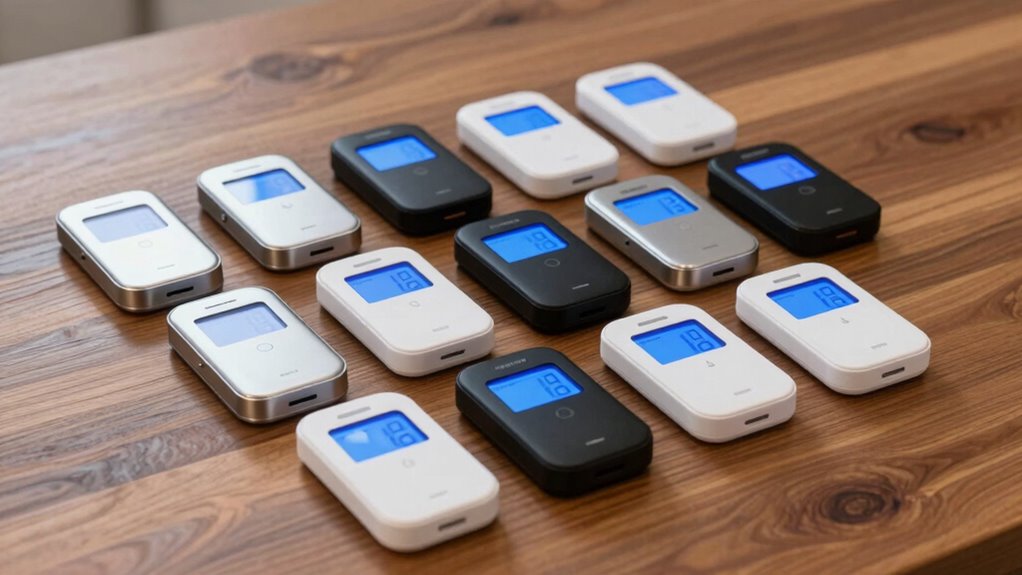

A pocket weight checker can mean a compact luggage scale or a small digital scale for weighing jewelry and other items, so the right pick depends on what you need to measure. My best overall choice is the Fuzion Digital Pocket Gram Scale, 200g x 0.01g with a 100g calibration weight, which pairs fine resolution with a calibration weight. For luggage, the Taylor Kinetic Powered Digital Luggage Scale stands out because it needs no batteries, while the MEIYA Coin Scale offers more capacity and several charging options for small-item weighing. The main tradeoffs are capacity versus precision, pocket size versus easy handling, and battery-free convenience versus digital features. Read on for the full breakdown of which style fits each job and what to check before choosing.
Complete the kit


Key Takeaways
- The lineup covers two different jobs: Taylor and the mechanical luggage scale handle suitcases, while the gram scales are designed for smaller items and finer readings.
- Most pocket gram scales top out at 200g or 300g: the MEIYA Coin Scale’s 600g capacity is the standout when an item may exceed those limits.
- Calibration weights are a useful distinction: several Fuzion, MAXUS, and GRAM PRES models include one, while the included weight differs across options.
- Precision is not the same as capacity: 0.01g readability suits small measurements, but it does not make a 200g scale appropriate for heavier objects.
- Power and handling shape travel convenience: Taylor avoids batteries, the mechanical luggage scale avoids a digital display, and compact gram scales prioritize small-item weighing.


| pocket weight checker | Display | Item weight | Material | Features |
|---|---|---|---|---|
| Taylor Kinetic Powered Digital | LCD | — | Plastic | Auto shut off, lightweight, portable |
| MEIYA Digital Fish Scale & Lug | Backlit LCD | 0.1 kg | Acrylonitrile butadiene styrene (ABS) | — |
| MEIYA Coin Scale | — | 0.17 kg | Stainless steel | — |
| Fuzion Digital Pocket Gram Sca | — | — | — | Backlit LCD, auto-off |
| Fuzion Digital Pocket Gram Sca | — | — | Acrylonitrile butadiene styrene (ABS), stainless steel | — |
| UNIWEIGH Travel Digital Pocket | Backlit LCD | 0.26 kg | — | — |
| UNIWEIGH Gram Scale | Backlit LCD | 0.21 kg | — | Auto shutoff, tare function, protective flip cover |
| MAXUS Pocket Scale | Backlit LCD | — | — | — |
| GRAM PRES Digital Pocket Scale | LCD with backlit display | 225 g | Acrylonitrile butadiene styrene (ABS) | Auto shutoff, tare function, protective lid |
| Mechanical Luggage Scale with | — | 0.18 kg | Paper | Locking weight display, built-in tape measure, foldable handle |
| Fuzion Digital Pocket Gram Sca | Backlit LCD | 7.04 ounces | — | X-shaped housing, rubberized grip, magnetic closure, auto shut-off, tare function |
More Details on Our Top Picks
Taylor Kinetic Powered Digital Luggage Scale, 110 lb Capacity, No Batteries Required, Lightweight Travel Scale with Durable Nylon Strap and Clip, Portable Suitcase Weight Checker for Travelers, White
For a pocket weight checker aimed at luggage, the Taylor stands apart because its kinetic power source needs no batteries. That makes it a practical choice for travelers who want to check a suitcase without keeping spare cells on hand. Its 110 lb capacity is well above the range needed for most bags, and the nylon strap and clip give it a straightforward way to attach to a handle. Compared with the battery-powered MEIYA Digital Fish Scale & Luggage Scale, the Taylor trades extras such as a tape measure and backlit display for simpler battery-free operation. The tradeoff is that it needs manual activation, and the display may be harder to read in bright sunlight. Choose it for luggage checks, not gram-level work: unlike the MEIYA Coin Scale or Fuzion pocket scales, it is not built for small, precise measurements.
Pros:- Kinetic power eliminates the need for replacement batteries.
- 110 lb capacity suits typical luggage checks.
- Nylon strap and clip provide a simple way to secure bags for weighing.
- Lightweight design is easy to pack.
Cons:- Manual activation is required to generate power.
- Display may be difficult to read in bright sunlight.
- Luggage-focused design cannot replace a precision pocket gram scale.
Best for: Frequent travelers who want a lightweight luggage checker without batteries to pack or replace.
Not ideal for: Collectors and cooks who need fractional-gram measurements, or travelers who prioritize an illuminated display for outdoor use.
- Weight capacity:110 lb
- Power source:Kinetic energy; no batteries required
- Display:LCD
- Material:Plastic
- Color:White
- Attachment:Nylon strap and clip
- Features:Auto shut off, lightweight, portable
Our verdict“Pick the Taylor for battery-free suitcase checks; choose the MEIYA luggage scale instead if a backlit display and tape measure matter more.”
MEIYA Digital Fish Scale & Luggage Scale with Comfortable Handle – 110lb/50kg High-Accuracy
The MEIYA combines a 110 lb luggage capacity with features that make readings easier to use: a backlit LCD, dual pound and kilogram units, and a retractable tape measure. Those extras give it an edge over the Taylor Kinetic Powered Digital Luggage Scale when weighing in dim conditions or when checking a bag’s dimensions as well as its weight. Its comfortable handle is also useful when a bag or catch takes longer to steady. The compromise is battery dependence, while the Taylor avoids that entirely. The plastic handle may also be less durable over time, so this is better suited to ordinary travel and occasional weighing than rough, frequent handling. It is still a luggage-and-fish scale, not a substitute for the MEIYA Coin Scale or Fuzion models when small-item precision is the priority.
Pros:- Backlit LCD helps with readings in dim settings.
- Displays measurements in pounds or kilograms.
- Retractable tape measure adds a quick bag-dimension check.
- Comfortable handle supports steadier weighing.
Cons:- Requires batteries, unlike the Taylor kinetic luggage scale.
- Plastic handle may be less durable with extended or rough use.
- 110 lb capacity and luggage-style format do not suit very heavy loads or tiny items.
Best for: Travelers who want a readable luggage scale with both pound and kilogram readings and a built-in tape measure.
Not ideal for: Battery-free travelers or jewelry and coin collectors who need a small platform with 0.01 g readability.
- Weight capacity:110 lb / 50 kg
- Measurement type:Digital
- Display:Backlit LCD
- Material:Acrylonitrile butadiene styrene (ABS)
- Color:Black
- Item weight:0.1 kg
- Additional features:Retractable tape measure, tare function, auto shut off, portable
Our verdict“Choose the MEIYA for readable travel weighing and a built-in tape measure, but pick the Taylor if avoiding batteries is your main concern.”
MEIYA Coin Scale, 600g x 0.01g Jewelry Scale with 7 Units & 3 Charging Interfaces
The MEIYA Coin Scale is the most adaptable pick here for small, valuable items: it measures up to 600 g at 0.01 g increments and offers seven units, including carats, pennyweights, and troy ounces. That wider capacity and broader unit selection make it more useful for jewelry and coin work than either Fuzion 200 g pocket scale, while its compact body remains easy to carry. It also stands apart from the Taylor and MEIYA luggage scale, which handle much heavier loads but cannot provide this kind of fine readout. The tradeoff is portability rather than luggage versatility: its 600 g ceiling rules out bags, and the charging cable is not included. The plastic cover may wear with repeated use, so buyers who want a simple battery-powered option may prefer the Fuzion Digital Pocket Gram Scale with its included calibration weight.
Pros:- 0.01 g readout supports fine measurements of small items.
- 600 g capacity exceeds the 200 g limit of the Fuzion pocket scales.
- Seven units include jewelry- and precious-metal-oriented measures.
- Rechargeable power and a compact body suit portable use.
Cons:- Charging cable is not included.
- Plastic cover may wear over time.
- 600 g maximum makes it unsuitable for luggage or heavier objects.
Best for: Coin collectors, jewelers, and metal buyers who need fine increments, multiple specialist units, and a portable scale.
Not ideal for: Travelers weighing suitcases or buyers who need a scale ready to charge straight from an included cable.
- Capacity:600 g
- Readout accuracy:0.01 g
- Units:g, ct, dwt, ozt, gn, tl, oz
- Dimensions:5.12 × 3.2 × 0.6 in
- Material:Stainless steel
- Item weight:0.17 kg
- Power:Rechargeable
Our verdict“Choose the MEIYA Coin Scale for portable, multi-unit jewelry and coin weighing; choose a Fuzion model if an included calibration weight matters more.”
Fuzion Digital Pocket Gram Scale 0.01g x 200g with 100g Calibration Weight
For buyers who want to check or recalibrate a pocket scale, this Fuzion pairs 0.01 g readability with an included 100 g calibration weight. Its stated 0.05 g minimum and ±0.03 g permissible error provide useful boundaries for small-item work, while the backlit LCD is a practical advantage over the other Fuzion 200 g model, whose listed specs do not specify a backlit display. It handles coins, jewelry, herbs, and small food portions, but its 200 g ceiling makes it far less versatile than the MEIYA Coin Scale’s 600 g capacity. The Fuzion’s calibration weight is valuable for maintenance, though buyers must supply two AAA batteries. It is a pocket scale for controlled, small loads—not a luggage checker like the Taylor or the MEIYA luggage model.
Pros:- 0.01 g readability suits fine measurements of small items.
- Includes a 100 g calibration weight.
- Backlit LCD supports reading in dim conditions.
- Lists a 0.05 g minimum and ±0.03 g permissible error.
Cons:- 200 g capacity limits it to small objects.
- Requires two AAA batteries.
- Display readability in low light is not specified beyond its backlight.
Best for: Small-item scale owners who want a supplied calibration weight and a clearly specified minimum load and error range.
Not ideal for: Travelers weighing bags, or collectors who regularly need more than 200 g capacity and specialist units beyond the listed modes.
- Capacity:200 g
- Readability:0.01 g
- Minimum load:0.05 g
- Permissible error:±0.03 g
- Units:g, oz, gn, ozt, dwt, ct
- Power:2 AAA batteries
- Included calibration weight:100 g
- Features:Backlit LCD, auto-off
Our verdict“Pick this Fuzion if a supplied 100 g calibration weight and stated measurement limits matter more than the MEIYA Coin Scale’s greater capacity.”
Fuzion Digital Pocket Gram Scale 200g/0.01g with 50g Calibration Weight
This Fuzion is a straightforward everyday choice for weighing coins, spices, herbs, and jewelry: it offers a 200 g capacity, 0.01 g readout, several measurement units, and easy calibration with the included 50 g weight. Its compact dimensions make it a more natural pocket carry than either luggage scale, while the MEIYA Coin Scale is the better fit for buyers who need up to 600 g or units such as tl. Compared with the other Fuzion in this group, this model lists a two-year warranty and has a 50 g calibration weight rather than 100 g. It runs on two AAA batteries, and the listed specs do not call out a backlit display, so it is less appealing for low-light work. Its 200 g limit also rules out luggage and larger objects.
Pros:- 0.01 g readout supports fine measurements.
- Compact 5.0 × 3.5 × 0.9 in body is suited to pocket storage.
- Multiple units and a 50 g calibration weight support flexible use.
- Two-year warranty is specified.
Cons:- 200 g capacity excludes luggage and heavier objects.
- Requires two AAA batteries.
- Listed specs do not identify a backlit display or advanced professional features.
Best for: People who want a compact, general-purpose scale for small household items, coins, or jewelry with easy calibration.
Not ideal for: Users weighing luggage, larger collectibles above 200 g, or small items in dim spaces where a confirmed backlit display is preferred.
- Weight capacity:200 g
- Readout accuracy:0.01 g
- Units:g, oz, gn, dwt, ct, ozt
- Dimensions:5.0 × 3.5 × 0.9 in
- Material:Acrylonitrile butadiene styrene (ABS), stainless steel
- Power:2 AAA batteries
- Included calibration weight:50 g
- Warranty:2 years
Our verdict“Choose this Fuzion for compact everyday small-item weighing and a stated warranty; pick the 100 g-calibration Fuzion for a larger calibration weight or the MEIYA for greater capacity.”
UNIWEIGH Travel Digital Pocket Scale 200g/0.01g, Digital Gram Scales
The UNIWEIGH Travel Digital Pocket Scale earns its place for travelers who need fine readings across several unit systems in a compact format. Its 0.01 g readability suits small items such as coins, jewelry, or spices, while the included 50 g calibration weight gives owners a way to recalibrate without sourcing an extra accessory. Compared with the UNIWEIGH Gram Scale 300g/0.01g, this model has less capacity, but its travel-oriented package includes two AAA batteries. The tradeoff is a firm 200 g ceiling: it is a poor fit for heavier objects or larger batches. Its small platform and body also call for careful handling, especially for users with larger hands. Choose it for lightweight, precise checks rather than general-purpose weighing.
Pros:- 0.01 g readability for measuring small items
- Six measurement units, including carats and troy ounces
- 50 g calibration weight and two AAA batteries are included
- Compact mini form suits travel storage
Cons:- 200 g capacity rules out heavier items and larger batches
- Small form may be awkward for users with larger hands
- Battery-powered operation requires replacement batteries eventually
Best for: Travelers who weigh small jewelry, coins, or spice portions and want several unit choices plus an included calibration weight
Not ideal for: Buyers weighing objects above 200 g or anyone who prefers a larger platform and easier-to-handle controls
- Capacity:200 g
- Readout accuracy:0.01 g
- Measurement units:Grams, ounces, grains, carats, pennyweight, troy ounces
- Display:Backlit LCD
- Form factor:Mini
- Item weight:0.26 kg
- Included components:Pocket scale, 50 g calibration weight, two AAA batteries, user manual
Our verdict“Pick this UNIWEIGH when portability, multiple units, and an included calibration weight matter more than capacity above 200 g.”
UNIWEIGH Gram Scale, 300g/0.01g High Precision Pocket Jewelry Scale
For buyers who want pocket-scale precision but regularly weigh more than tiny samples, the UNIWEIGH Gram Scale offers a useful step up to 300 g capacity while retaining 0.01 g readability. That extra headroom separates it from the 200 g UNIWEIGH Travel Digital Pocket Scale, making it a better match for somewhat larger jewelry lots or ingredient portions. A stainless steel platform and protective flip cover add practical protection for a scale carried in a bag. Its LCD is backlit, and tare and auto-shutoff functions support everyday weighing. The tradeoffs are the same capacity limit that rules out heavier gear and unspecified battery inclusion. Its distinctive styling may also be less appealing to shoppers seeking an understated travel accessory.
Pros:- 300 g capacity exceeds the 200 g UNIWEIGH Travel model
- 0.01 g readability supports small-item measurements
- Stainless steel platform and protective flip cover suit portable use
- Backlit LCD, tare function, and auto shutoff are included
Cons:- Still limited to small items weighing no more than 300 g
- Battery inclusion is not specified
- Styling may not suit buyers who prefer a neutral appearance
Best for: Jewelry makers and hobbyists who need 0.01 g readability with more weighing headroom than a 200 g pocket scale
Not ideal for: Travelers weighing luggage or larger objects, and buyers who need a confirmed battery package or a subdued design
- Capacity:300 g
- Readout accuracy:0.01 g
- Units:Grams, ounces, grains, carats, pennyweight, troy ounces
- Platform:Stainless steel
- Display:Backlit LCD
- Features:Auto shutoff, tare function, protective flip cover
- Item weight:0.21 kg
Our verdict“Choose this model over the 200 g UNIWEIGH if you need extra capacity without giving up fine readability or a protective cover.”
MAXUS Pocket Scale, 200g x 0.01g, with 50g Calibration Weight and USB Cable
The MAXUS Pocket Scale stands apart from the battery-only pocket models here with battery-or-USB power, giving buyers a choice between portable use and powering the scale by cable. Its 0.01 g readability and backlit LCD are suited to small items, while the included 50 g calibration weight helps with periodic recalibration. Compared with the 300 g GRAM PRES Digital Pocket Scale, MAXUS gives up 100 g of capacity, so it is better for compact loads than larger batches. The stated dimensions—5.43 by 3.15 by 0.98 inches—also make it less of a bare-minimum pocket option than the smallest designs. Frequent battery use may mean more replacements, and the 200 g ceiling limits its range.
Pros:- USB or battery power offers more flexibility than battery-only models
- 0.01 g readability and a backlit LCD aid small-item weighing
- 50 g calibration weight is included
- Six units cover common jewelry and general weighing needs
Cons:- 200 g capacity is below the 300 g GRAM PRES and UNIWEIGH models
- Frequent battery use may require regular replacement
- Calibration may be needed to maintain accurate readings
Best for: People who weigh small objects at home and while traveling and want USB power as an alternative to batteries
Not ideal for: Buyers who need capacity above 200 g or the smallest possible scale for a pocket
- Capacity:200 g
- Readability:0.01 g
- Dimensions:5.43 × 3.15 × 0.98 inches
- Display:Backlit LCD
- Units:Grams, ounces, troy ounces, pennyweight, carats, grains
- Power:Batteries or USB
- Calibration weight:50 g
- Weight:4.8 ounces
Our verdict“Choose MAXUS if dual power matters more than the extra 100 g capacity offered by the 300 g pocket scales.”
GRAM PRES Digital Pocket Scale 300g/0.01g Accuracy with 50g Calibration Weights
The GRAM PRES Digital Pocket Scale is a strong fit for buyers who want a 300 g limit, fine readability, and practical weighing controls in one compact device. Its tare function lets users zero a container before adding a sample, while the backlit display helps with readings in dimmer settings. Compared with the 200 g MAXUS Pocket Scale, GRAM PRES handles a heavier load, though it does not list MAXUS’s USB power option. The six unit choices suit jewelry and small-item weighing, and a protective lid helps during storage. Its ABS construction is less explicitly metal-focused than the stainless-steel platforms on MAXUS and the 300 g UNIWEIGH. The small format and 300 g cap still make it unsuitable for bulky objects.
Pros:- 300 g capacity gives more headroom than the 200 g MAXUS
- 0.01 g readability and tare function support small-item weighing
- Backlit LCD and auto shutoff are practical for portable use
- Multiple units cover jewelry and general small-item measurements
Cons:- Capacity remains too low for larger objects or luggage
- ABS material lacks the listed stainless steel platform of the MAXUS and UNIWEIGH 300 g model
- Battery operation means replacement batteries will be needed
Best for: Jewelry and hobby users who want 300 g capacity, tare control, and a backlit display in a pocket-sized scale
Not ideal for: People weighing bulky items, or buyers who specifically want USB power or a stated stainless steel platform
- Capacity:300 g
- Readout accuracy:0.01 g
- Measurement units:Grams, ounces, troy ounces, pennyweight, carats, grains
- Material:Acrylonitrile butadiene styrene (ABS)
- Item weight:225 g
- Display:LCD with backlit display
- Features:Auto shutoff, tare function, protective lid
Our verdict“Pick GRAM PRES for 300 g capacity and tare controls, but choose MAXUS instead if USB power is a priority.”
Mechanical Luggage Scale with Tape Measure, Up to 80 Pounds (Blue)
This mechanical luggage scale serves a different job from the gram-scale options in this roundup: it checks suitcase weight rather than tiny objects. Its 80-pound capacity is far above the 200–300 g limits of the UNIWEIGH and GRAM PRES pocket scales, while the built-in tape measure adds a quick way to check luggage dimensions. Because it is mechanical, it needs no batteries, and the locking analog dial holds the reading for easier viewing after lifting a bag. A foldable handle supports compact storage. The tradeoff is precision: an analog luggage scale is not a substitute for a 0.01 g pocket scale, and the listed paper material may be less reassuring for buyers seeking a more rugged build. Choose it for travel bags, not small-item weighing.
Pros:- 80-pound capacity is suited to luggage, unlike the gram scales in this roundup
- Mechanical operation requires no batteries
- Integrated tape measure checks luggage size as well as weight
- Locking dial and foldable handle support reading and storage
Cons:- Analog readout is not comparable to 0.01 g digital precision
- 80-pound limit may not suit loads beyond its stated capacity
- Listed paper material may be less durable than a metal-bodied alternative
Best for: Air travelers who want a battery-free way to check suitcase weight and dimensions before leaving home
Not ideal for: Jewelry makers, cooks, or anyone who needs gram-level measurements for small items
- Weight capacity:80 pounds
- Readout type:Analog
- Measurement type:Mechanical
- Material:Paper
- Item weight:0.18 kg
- Features:Locking weight display, built-in tape measure, foldable handle
- Color:Blue
Our verdict“Choose this scale for suitcase checks and built-in size measuring, not as a pocket checker for small items.”
Fuzion Digital Pocket Gram Scale 200g x 0.01g with 50g Calibration Weight
This Fuzion is a strong fit when a pocket-sized checker needs fine 0.01g increments and more than one way to display a reading. Its six units, including grams, carats, and pennyweights, suit small jewelry, coins, and similar items better than a luggage scale such as the Taylor Kinetic, which is built for suitcase loads rather than tiny measurements. The included 50g calibration weight gives you a reference for recalibration, though the scale may need recalibration over time. Its rubberized grip and magnetic closure help with carrying and handling, while the backlit display supports quick readings. The tradeoff is a 200g ceiling: this is for small objects, not parcels or travel bags. It also runs on batteries, unlike the Taylor’s kinetic-powered design.
Pros:- 0.01g display resolution supports fine measurements of small items.
- Six measurement units include carats and pennyweights for jewelry tasks.
- Included 50g calibration weight provides a reference for recalibration.
- Rubberized grip, magnetic closure, and backlit LCD suit portable use.
Cons:- The 200g maximum excludes most parcels and all luggage weighing.
- Battery-powered operation requires working batteries.
- May need recalibration over time.
Best for: Jewelry makers, coin collectors, and hobbyists who want 0.01g readings plus carat and pennyweight units in a portable scale.
Not ideal for: Travelers weighing suitcases or buyers weighing heavier parcels, since its capacity stops at 200g and it is not designed for luggage.
- Maximum capacity:200g
- Display resolution:0.01g
- Measurement units:g, oz, gn, ct, ozt, dwt
- Calibration weight:50g included
- Materials:ABS, rubber, stainless steel
- Item weight:7.04 ounces
- Features:X-shaped housing, rubberized grip, magnetic closure, auto shut-off, tare function
- Display:Backlit LCD
Our verdict“Choose this Fuzion for portable, fine-resolution weighing across jewelry-friendly units; skip it if you need to check luggage or heavier packages.”

How We Picked
I ranked these by fit for the task implied by their design, rather than treating every product as interchangeable. For suitcase checks, I focused on stated capacity, carrying convenience, the weighing mechanism, and practical extras such as a strap or tape measure. For pocket gram scales, I compared capacity, stated 0.01g readability, included calibration weights, and power or charging details where provided.
The top positions go to options with a clear advantage for their intended buyer, not simply the longest feature list. I also weighed usability and likely tradeoffs: a high-capacity gram scale serves a different need from a compact 200g model, and a luggage scale cannot replace a precision pocket scale. Product details supplied here do not establish independent accuracy testing, so I treat accuracy claims as specifications, not verified performance.
| pocket weight checker | Display | Material | Features |
|---|---|---|---|
| Taylor Kinetic Powered Digital | LCD | Plastic | Auto shut off, lightweight, portable |
| MEIYA Digital Fish Scale & Lug | Backlit LCD | Acrylonitrile butadiene styrene (ABS) | — |
| MEIYA Coin Scale | — | Stainless steel | — |
| Fuzion Digital Pocket Gram Sca | — | — | Backlit LCD, auto-off |
| Fuzion Digital Pocket Gram Sca | — | Acrylonitrile butadiene styrene (ABS), stainless steel | — |
| UNIWEIGH Travel Digital Pocket | Backlit LCD | — | — |
| UNIWEIGH Gram Scale | Backlit LCD | — | Auto shutoff, tare function, protective flip cover |
| MAXUS Pocket Scale | Backlit LCD | — | — |
| GRAM PRES Digital Pocket Scale | LCD with backlit display | Acrylonitrile butadiene styrene (ABS) | Auto shutoff, tare function, protective lid |
| Mechanical Luggage Scale with | — | Paper | Locking weight display, built-in tape measure, foldable handle |
| Fuzion Digital Pocket Gram Sca | Backlit LCD | — | X-shaped housing, rubberized grip, magnetic closure, auto shut-off, tare function |
Factors to Consider When Choosing Pocket Weight Checker
Before choosing a pocket weight checker, decide what you will weigh and how often. A suitcase scale and a gram scale may both be portable, but they solve different problems and use different measurement ranges. These checks can help you avoid buying a compact scale that is precise but too small for your object—or a luggage scale that cannot resolve small amounts.
Match the scale type to the object
Start with the item, not the word “pocket” in the product name. A luggage scale is made to support a bag by its handle or strap; a gram scale uses a weighing surface for smaller objects. Neither format is a sensible substitute for the other: a suitcase scale is not designed to measure tiny portions, and a pocket gram scale may have a capacity far below a packed bag. Think through the largest and smallest items you expect to weigh before comparing models. If you need both jobs, buying one device for each may be more practical than compromising with the wrong format.
Choose capacity with room to spare
Capacity is the maximum load the scale is designed to measure, not a promise that every object below that limit will be easy to weigh. For luggage, allow for a packed bag that may be heavier than expected; for small-item scales, compare the scale’s limit with the container or platform you will use. A 300g pocket scale gives more headroom than a 200g model, while the 600g MEIYA Coin Scale extends that range further. Do not select capacity alone, though: higher capacity does not automatically mean better performance at the light end. A scale that is frequently used near its maximum may also be less convenient than one sized for the typical load.
Read resolution claims in context
A stated 0.01g increment tells you how finely a display can show readings; it does not, by itself, prove that measurements are accurate to 0.01g. That distinction matters when weighing small amounts, where placing an object off-center or weighing on an unstable surface can affect the result. For travel, a clear reading around the relevant suitcase limit usually matters more than hundredths of a gram. For jewelry or other small items, fine increments are more relevant, but users should still follow the maker’s instructions and check calibration. Avoid paying extra for a fine display if the scale’s capacity or measurement method does not suit your task.
Treat calibration as a check, not a guarantee
An included calibration weight can make it easier to check or adjust a scale when its instructions support that process. It does not certify the product, guarantee long-term accuracy, or replace careful setup. Check whether the supplied weight matches the calibration procedure and whether the manual explains how to use it. Keep the weight clean and stored safely; losing it removes a convenient reference. If repeatability matters for your work, also weigh on a firm, level surface and avoid drafts, vibration, or contact with the scale while a reading settles.
Factor power and travel habits into the choice
For a scale kept in luggage, power is a usability issue: dead batteries can make a digital device unavailable when you need it. The Taylor kinetic model avoids that battery dependency, while rechargeable or USB-powered designs may suit someone who already carries charging cables. A mechanical scale sidesteps charging altogether, but its display and operation differ from digital readouts. Check the actual power details before assuming a cable or charging interface is included or compatible with your routine. Also think about storage: a strap, protective cover, or compact footprint can matter more than extra functions on a device used only occasionally.
Separate useful features from distracting extras
Extra units, a tape measure, a comfortable handle, or multiple charging interfaces are valuable only when they support how you weigh. Unit options can reduce conversion errors if you switch between measurement systems, while a tape measure can help with baggage dimensions but cannot replace checking an airline’s current rules. A comfortable handle matters more when lifting a heavy bag than when weighing a ring. Before buying, list the two or three tasks you actually expect to perform and favor features that make those tasks simpler. This prevents a feature-rich scale from winning over a better-fitting, easier-to-carry option.
Frequently Asked Questions
Can one pocket weight checker measure both a suitcase and jewelry?
Usually, one device is not a good fit for both jobs. Luggage scales are built for heavier loads and use a strap or handle, while pocket gram scales focus on small objects and fine display increments. The luggage models in this roundup are rated for loads up to 110lb or 80lb, whereas the gram-scale options have capacities from 200g to 600g. A gram scale cannot safely replace a luggage scale, and a luggage scale is not intended for small, precise measurements. If you need both uses, choose separate devices based on each task.
Is a 0.01g pocket scale accurate enough for jewelry?
A 0.01g display increment can be useful for weighing small jewelry items, but the number alone does not establish measurement accuracy. Setup, surface stability, calibration, and the object’s placement can all affect the reading. Check the scale’s capacity against the item and any weighing container, and consult its instructions for calibration and use. If the measurement has financial or professional consequences, confirm it with an appropriate verified instrument rather than relying only on a consumer scale’s stated resolution. For casual weighing, fine readability may still be a helpful feature.
Should I choose a 200g, 300g, or 600g pocket scale?
Choose based on the heaviest item you expect to weigh, including any container placed on the platform. A 200g model is suited to lighter, compact tasks; 300g provides additional headroom; and the 600g MEIYA Coin Scale accommodates a broader range of small-item loads. More capacity is not automatically better if you mainly need a compact scale for lighter objects. Also compare the smallest measurement you care about, since maximum capacity does not describe low-weight performance. When uncertain, allow some margin above your usual load without treating that as a substitute for checking the stated specifications.
Does an included calibration weight mean a scale will stay accurate?
No. A calibration weight is a reference that can help you check or adjust a scale when the manufacturer’s procedure allows it; it does not guarantee accuracy over time. Handling, storage, changes in position, and the weighing surface can affect readings. Follow the scale’s instructions and keep the supplied weight clean and protected. If readings matter for a specific purpose, check them periodically and compare against an appropriate reference. The Fuzion, MAXUS, and GRAM PRES listings include calibration weights, but that feature should be treated as a practical aid rather than proof of verified accuracy.
Is a battery-free luggage scale a better travel choice than a digital one?
It can be a better fit if you want to avoid carrying spare batteries or charging cables. The Taylor kinetic scale is the battery-free digital option in this group, while the mechanical luggage scale avoids a digital power source but uses a different readout style. A conventional digital scale may better suit someone who prefers its display or already manages power for other travel devices. Compare the scale’s capacity, handling, and how easily you can read it while lifting a bag. Your travel routine—not the power method alone—should decide between them.
Conclusion
For a single small-item scale, I would choose the Fuzion 200g x 0.01g model with the 100g calibration weight as the best overall balance in this lineup. The best value depends on your job: choose a straightforward 200g pocket scale for everyday small-item weighing, or the Taylor Kinetic if battery-free luggage checks are your priority. The best premium-style option for broader small-item capacity is the MEIYA Coin Scale, with its 600g limit and multiple charging interfaces. For beginners, a familiar 200g pocket scale with a supplied calibration weight offers a simple place to start; for suitcase-only use, skip the gram scales and pick Taylor or the mechanical luggage model. If your specific need is weighing heavier small objects, the 600g MEIYA has the clearest capacity advantage.