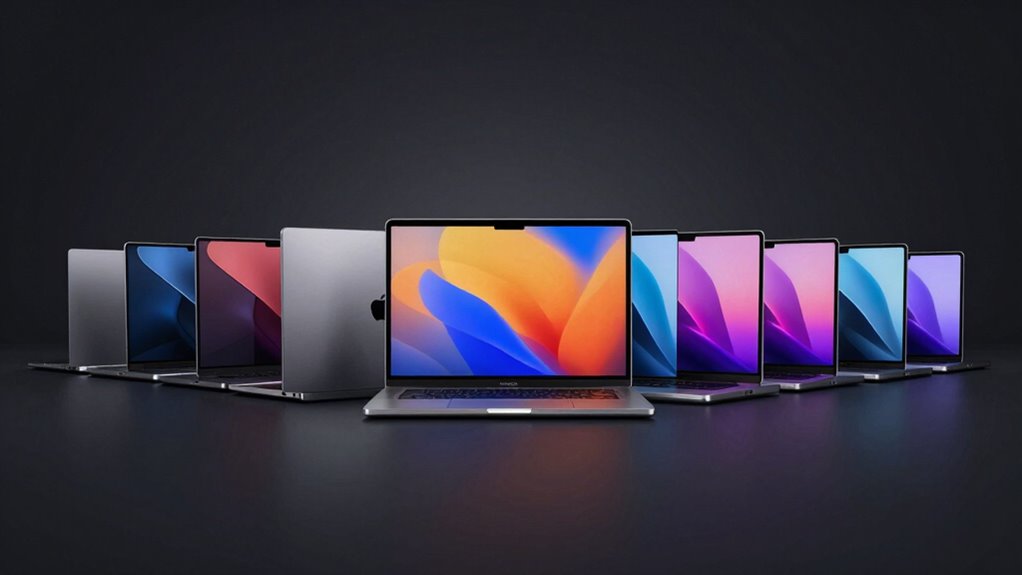

Shopping for 4TB MacBook Pro laptops means deciding whether you need a true 4TB internal drive, the newest performance, or a lower-cost way to keep a large project library on your computer. My first pick for maximum capability is the M5 Max 16-inch with 128GB memory; the renewed M1 Max 16-inch is the more grounded option if you want a listed 4TB SSD without needing the newest chip. The 2020 Intel 13-inch is a separate, older and more compact route, but it carries bigger software-age and renewed-condition tradeoffs.

Get home office essentials delivered free with Prime
- Fast, free delivery on millions of items
- Prime Video, Amazon Music and more included
- Member-only deals all year
There is one important distinction in this lineup: the 2026 M5 Pro model has a 1TB SSD, not 4TB. I include it as a useful current-generation comparison, not as a match for buyers who require 4TB built in. The two M5 Max listings share the same core processor, memory, and storage configuration, so their order reflects the information provided rather than a claimed performance difference. My ranking weighs storage fit first, then chip capability, memory, display, portability, and the risks of buying renewed.
Key Takeaways
- Only four listings specify a 4TB internal SSD; the 2026 M5 Pro has 1TB and does not meet a strict 4TB requirement.
- The M5 Max with 128GB memory is the strongest fit for GPU-heavy creative work and large on-device workloads, but its listed 8.2-pound weight is a substantial portability penalty.
- The renewed M1 Max combines a 4TB SSD, 64GB memory, and a 120Hz XDR display, but its older chip generation and renewed condition matter.
- The two M5 Max 4TB configurations list the same headline chip, memory, and storage; compare listing details and included items rather than assuming one is faster.
- The 2020 Intel model offers 4TB in a 13.3-inch format, but its older processor and Intel graphics make it a specialist legacy option, not a modern performance peer.


| 4tb macbook pro laptop | Memory | Storage | Display | Chip |
|---|---|---|---|---|
| Apple MacBook Pro 16.2-Inch wi | 128GB unified memory | 4TB SSD | 16.2-inch Liquid Retina XDR | Apple M5 Max |
| Apple 16-inch MacBook Pro with | 128GB unified memory | 4TB SSD | 16.2-inch Liquid Retina XDR | Apple M5 Max |
| Apple 2021 MacBook Pro 16-inch | 64GB unified memory | 4TB SSD | 16.2-inch Liquid Retina XDR, 120Hz | Apple M1 Max |
| 2020 Apple MacBook Pro 13.3-in | 32GB LPDDR4X | 4TB SSD | 13.3-inch LED, 3840 × 2160 pixels | — |
| Apple 2026 MacBook Pro Laptop | 48GB unified memory | 1TB SSD | 16.2-inch Liquid Retina XDR | Apple M5 Pro |
More Details on Our Top Picks
Apple MacBook Pro 16.2-Inch with M5 Max, 18-Core CPU, 40-Core GPU, 128GB Memory, 4TB SSD, Space Black
For a buyer who genuinely needs both 4TB of internal storage and top-tier compute, this M5 Max configuration is the most capable match in the lineup. Its 18-core CPU, 40-core GPU, and 128GB unified memory are aimed at large creative projects, graphics-heavy work, and demanding local workloads. Compared with the renewed M1 Max, it has a newer chip generation and twice the listed memory, making it a stronger choice for work that can use that headroom. The 16.2-inch Liquid Retina XDR display and broad set of ports also suit a desk-based production setup.
The tradeoff is unusually clear: the supplied specification lists 8.2 pounds, which makes this a poor fit for buyers who carry a laptop all day. That figure is striking for a 16-inch MacBook Pro, so I would verify the listing details before ordering rather than assume it reflects the weight of a typical configuration. It also costs you the opportunity to choose a lighter, less powerful machine if your projects do not need a 40-core GPU or 128GB memory. Compared with the M5 Pro model, this is the better fit for a built-in 4TB requirement and heavier graphics work, but the M5 Pro is the more sensible direction for buyers who can work with 1TB.
I rank it first because it combines the newest listed chip family in the 4TB group with the largest memory pool and professional connectivity. Its advantage is workload capacity, not value for every owner. If your files are mostly documents, photos, and routine video, the M1 Max or even the non-4TB M5 Pro may be a more proportionate choice.
Pros:- 4TB internal SSD paired with 128GB unified memory
- M5 Max chip with an 18-core CPU and 40-core GPU
- 16.2-inch Liquid Retina XDR display
- Thunderbolt 5, HDMI, SDXC, and MagSafe 3 connections
Cons:- The supplied listing states a heavy 8.2-pound weight that should be confirmed
- Its compute and memory capacity may be unnecessary for many buyers
- The provided details do not specify a warranty or condition
Best for: Video, 3D, graphics, and other professional users who need a 4TB internal drive, substantial memory, and high-end GPU capability.
Not ideal for: Frequent commuters, casual users, and anyone who does not need M5 Max-level graphics or 128GB of memory; verify the unusual listed weight before buying.
- Chip:Apple M5 Max
- CPU / GPU:18-core CPU / 40-core GPU
- Memory:128GB unified memory
- Storage:4TB SSD
- Display:16.2-inch Liquid Retina XDR
- Weight:8.2 pounds, as listed
- Ports:Three Thunderbolt 5, MagSafe 3, SDXC, HDMI, headphone jack
- Wireless:Wi-Fi 7, Bluetooth 6
Our verdict“I recommend this M5 Max configuration for demanding professionals who need a 4TB internal drive and can accept a heavy, high-capacity machine.”
Apple 16-inch MacBook Pro with M5 Max, 18-core CPU, 40-core GPU, 128GB Memory, and 4TB SSD
This listing shares the central configuration of my top pick: M5 Max, 128GB unified memory, and a 4TB SSD. That makes it a strong fit for the same demanding professional workloads, including large creative projects and intensive on-device processing. The 16.2-inch Liquid Retina XDR display is specified with 1600-nit peak brightness, up to 1000-nit sustained brightness, and a 1,000,000:1 contrast ratio. Those details make the screen a meaningful part of the package for people who work with HDR material or want a bright, high-contrast built-in display.
Compared with the first M5 Max listing, the supplied information does not identify a different CPU, GPU, memory, or SSD. I would not treat this model as faster on that basis. Instead, its distinct role is a second listing for the same high-capacity tier, with extra display and included-power details stated. The 140W USB-C adapter and USB-C to MagSafe 3 cable are listed, while the other M5 Max listing gives more detail about wireless connections, ports, camera, and weight. Buyers should compare the live listing and seller terms, because the available details do not establish a performance gap.
This configuration is still overkill for ordinary office tasks, and the provided description does not give a weight, warranty, or condition. I place it just behind the first M5 Max option because that listing specifies more of the machine’s practical connections and weight, not because this one has weaker core hardware. For a buyer focused on screen specifications and the same 4TB/M5 Max tier, it remains a compelling match, subject to confirming the rest of the listing.
Pros:- M5 Max with an 18-core CPU and 40-core GPU
- 4TB SSD and 128GB unified memory
- 16.2-inch XDR display with stated brightness and contrast figures
- 140W adapter and MagSafe 3 cable are specified
Cons:- Core performance specifications match the other M5 Max listing, so no speed advantage is established
- Weight, warranty, and condition are not supplied
- Apple Intelligence features are described as beta and may vary by region or language
Best for: Creative professionals seeking an M5 Max, 128GB memory, and 4TB SSD, especially those prioritizing stated XDR brightness and contrast figures.
Not ideal for: Buyers who need a clearly documented weight, condition, or warranty before choosing, or who would not use the M5 Max’s graphics and memory capacity.
- Chip:Apple M5 Max
- CPU / GPU:18-core CPU / 40-core GPU
- Memory:128GB unified memory
- Storage:4TB SSD
- Display:16.2-inch Liquid Retina XDR
- Brightness:1600 nits peak; up to 1000 nits sustained
- Contrast:1,000,000:1
- Power accessories:140W USB-C adapter; 2 m USB-C to MagSafe 3 cable
Our verdict“I would choose this M5 Max listing for its display detail and stated included adapter, after confirming seller terms and the missing practical specifications.”
Apple 2021 MacBook Pro 16-inch with M1 Max, 64GB RAM, 4TB SSD (Renewed)
The renewed 2021 16-inch MacBook Pro is the most balanced choice here for someone who needs a 4TB SSD and 64GB of memory but does not require the newest M5 Max hardware. Its M1 Max has a 10-core CPU and 32-core GPU, and the 16.2-inch Liquid Retina XDR screen adds a 120Hz refresh rate and listed peak brightness of 1600 nits. Compared with the 2020 Intel model, it is a more recent Apple silicon configuration with a stronger stated graphics setup and a larger screen. It is also less extreme than either M5 Max listing in memory and GPU specification, which can be an advantage if 128GB would go unused.
The catch is its renewed condition. The product details state a 90-day limited warranty and note that condition may vary, so I would check exactly what the seller covers and what accessories are included. Its M1 Max is older than the M5 Max options, and buyers focused on the newest generation or particularly demanding future workloads should favor those newer configurations if the extra capacity is justified. On the other hand, the M1 Max provides a clear 4TB internal drive and 64GB memory without the unusual 8.2-pound weight listed for the first M5 Max machine.
This is my value-minded workstation pick by configuration, not a claim about its purchase price. It suits people who need a large internal project library, a capable GPU, and a high-quality display but can accept a refurbished or renewed product. Skip it if you want a new machine, a longer documented warranty, or the newest chip family.
Pros:- 4TB SSD and 64GB unified memory
- M1 Max with a 32-core GPU
- 16.2-inch XDR display with 120Hz refresh
- A stated 90-day limited warranty
Cons:- Renewed condition may vary
- Older M1 Max generation than the M5 Max configurations
- Warranty coverage is limited to the stated 90-day period
Best for: Creative users who want a 4TB internal SSD, 64GB memory, and a large XDR display in a renewed Apple silicon laptop.
Not ideal for: Buyers who require a new-in-box Mac, a clearly uniform condition, or the latest M5 Max generation.
- Model year:2021
- Chip:Apple M1 Max
- CPU / GPU:10-core CPU / 32-core GPU
- Memory:64GB unified memory
- Storage:4TB SSD
- Display:16.2-inch Liquid Retina XDR, 120Hz
- Peak brightness:1600 nits
- Condition / warranty:Renewed; 90-day limited warranty
Our verdict“I recommend this renewed M1 Max when 4TB and 64GB matter more than buying the newest generation.”
2020 Apple MacBook Pro 13.3-inch, Intel Core i5 2.0 GHz, 32 GB RAM, 4 TB SSD, Space Gray (Renewed)
This 2020 13.3-inch MacBook Pro is the small-screen alternative for buyers who want a 4TB internal SSD in a more compact chassis. Its 32GB memory is substantial for an Intel-era 13-inch model, and the listing says the renewed battery exceeds 80% of its original capacity. Compared with the 16-inch M1 Max, though, it has a four-core Intel Core i5 and integrated Intel Iris Plus graphics rather than a dedicated high-core-count Apple silicon GPU. That makes the smaller model a weaker match for graphics-heavy editing, complex 3D work, or intensive modern workloads.
The listing specifies a 3840 × 2160 display resolution, four Thunderbolt and USB-C ports, and a Touch Bar. Those details may appeal to someone who wants a compact legacy Mac for storage-heavy work, older software, or a secondary machine. But a high stated resolution does not erase its age: this is a 2020 Intel laptop running macOS Ventura as listed, not a current-generation performance competitor. Buyers should check software compatibility and support needs before treating it as a main machine for years ahead.
Its renewed status adds another layer of uncertainty. The supplied details say it is inspected, tested, and cleaned, with a battery above 80% capacity, but accessories may be compatible replacements and the packaging may be generic. I rank it below the M1 Max because the smaller size does not compensate for the weaker graphics and older platform for most professional work. It makes sense only when compactness, Intel compatibility, and built-in 4TB outweigh those limitations.
Pros:- 4TB SSD and 32GB memory in a 13.3-inch model
- Four Thunderbolt and USB-C ports are listed
- Renewed battery is stated to exceed 80% of original capacity
- Replacement or refund coverage is listed for 90 days
Cons:- Four-core Intel Core i5 and integrated graphics are far behind the M1 Max and M5 Max configurations
- Renewed accessories may not be original and packaging may be generic
- Older platform and listed macOS Ventura require software-support checks
Best for: Buyers who need a compact 13.3-inch Mac with 4TB storage for legacy-compatible, storage-heavy tasks and accept renewed Intel hardware.
Not ideal for: Users seeking modern GPU performance, long-term software headroom, a new machine, or a large screen for sustained creative work.
- Model year:2020
- Processor:Intel Core i5, 2.0 GHz, 4 cores
- Memory:32GB LPDDR4X
- Storage:4TB SSD
- Display:13.3-inch LED, 3840 × 2160 pixels
- Graphics:Integrated Intel Iris Plus
- Ports:Four Thunderbolt and USB Type-C
- Condition:Renewed; battery stated above 80% of original capacity
Our verdict“I would choose this compact Intel model only when 4TB, small size, and legacy compatibility outweigh modern performance and support concerns.”
Apple 2026 MacBook Pro Laptop with M5 Pro Chip, 16.2-inch Liquid Retina XDR Display, 48GB Memory, 1TB SSD, Space Black
This 2026 MacBook Pro earns a place in the comparison because it shows the tradeoff between a newer-generation system and a strict 4TB built-in storage requirement. Its M5 Pro chip, 48GB unified memory, and 16.2-inch Liquid Retina XDR display make it a capable configuration for demanding professional work. The three Thunderbolt 5 ports, HDMI, SDXC, and MagSafe 3 also give it a strong set of connection options. Against the renewed M1 Max, it offers a newer chip generation and more current connectivity, but the listed SSD is only 1TB, leaving a four-times-smaller internal capacity than the 4TB options.
That storage difference is decisive for this roundup. If your aim is to keep several large video projects, sample libraries, or local archives on the laptop, the M1 Max or M5 Max models fit the brief more directly. If you can store most files externally or in network storage, the M5 Pro may be a better modern system for your workload than an older renewed laptop. Its 48GB memory also sits below the 64GB M1 Max and 128GB M5 Max configurations, so large memory-heavy projects may point elsewhere.
I rank it last only because it does not meet the title’s 4TB specification; that is not a judgment that it is a poor laptop. At 4.71 pounds, it is also more portable than the 8.2-pound figure supplied for the top M5 Max listing, although it remains a large 16-inch computer. Choose it when current-generation M5 Pro capability matters more than having 4TB installed from the start, and skip it if the internal capacity is non-negotiable.
Pros:- 2026 M5 Pro chip with 18-core CPU and 20-core GPU
- 48GB unified memory
- 16.2-inch Liquid Retina XDR display
- Thunderbolt 5, HDMI, SDXC, and MagSafe 3
Cons:- 1TB SSD does not meet a strict 4TB requirement
- Less memory than the listed 4TB M1 Max and M5 Max configurations
- At 4.71 pounds, it remains a sizable laptop to carry
Best for: Buyers who want a 2026 M5 Pro MacBook Pro and can manage with 1TB internal storage or use external storage.
Not ideal for: Anyone whose core requirement is a 4TB internal SSD or whose projects depend on 64GB to 128GB of unified memory.
- Chip:Apple M5 Pro
- CPU / GPU:18-core CPU / 20-core GPU
- Memory:48GB unified memory
- Storage:1TB SSD
- Display:16.2-inch Liquid Retina XDR
- Weight:4.71 pounds
- Ports:Three Thunderbolt 5, MagSafe 3, SDXC, HDMI, headphone jack
- Connectivity:Wi-Fi 7, Bluetooth 6
Our verdict“I recommend this newer M5 Pro only when current-generation capability matters more than having 4TB of internal storage.”

How We Picked
I ranked these machines around the phrase 4TB MacBook Pro, so a listed 4TB internal SSD matters more than a newer model year or a general claim of professional capability. That immediately separates the four 4TB configurations from the M5 Pro comparison model, which has just 1TB. I retain that model because it helps clarify the choice between buying a recent, powerful MacBook Pro with less built-in capacity and choosing an older or more specialized 4TB configuration.
Among the 4TB options, I compared chip generation and graphics capability, unified memory, screen size and display details, listed weight, ports, and condition. The M5 Max configurations lead for compute and memory capacity; the M1 Max balances a substantial 4TB setup with a 64GB memory specification; and the Intel machine trades newer architecture for a smaller body and a 4TB drive. Renewed condition is a real buying factor, so I call out the provided warranty or condition notes rather than treating those laptops as equivalent to new systems. When two listings have overlapping core specifications, I avoid inventing differences that the supplied details do not support.
This is a comparison of the supplied configurations, not a claim that every machine was independently tested. Product details, availability, operating-system support, and listing contents can change; I use the stated specifications and flag missing or unusual details where they affect the decision. My ranking is meant to help match the configuration to a workload, not to imply that every buyer needs the most powerful option.
| 4tb macbook pro laptop | Chip | Ports |
|---|---|---|
| Apple MacBook Pro 16.2-Inch wi | Apple M5 Max | Three Thunderbolt 5, MagSafe 3, SDXC, HDMI, headphone jack |
| Apple 16-inch MacBook Pro with | Apple M5 Max | — |
| Apple 2021 MacBook Pro 16-inch | Apple M1 Max | — |
| 2020 Apple MacBook Pro 13.3-in | — | Four Thunderbolt and USB Type-C |
| Apple 2026 MacBook Pro Laptop | Apple M5 Pro | Three Thunderbolt 5, MagSafe 3, SDXC, HDMI, headphone jack |
Factors to Consider When Choosing 4tb Macbook Pro Laptops
I would start with a simple question: must the 4TB be installed internally? If yes, set aside the M5 Pro comparison model and choose among the four listings that specify a 4TB SSD. Then match the chip and condition to your actual workload; storage capacity alone does not make an older laptop a better professional workstation.
Decide Whether 4TB Must Be Built In
A 4TB internal SSD is valuable when you need large projects accessible without external drives: video libraries, photo catalogs, audio sessions, or local datasets. It also reduces dependence on adapters and external storage while moving between locations. But not everyone needs to keep every file on the laptop. If active projects fit within 1TB and archives can live on an external SSD or network storage, the 2026 M5 Pro may be the better system despite missing the roundup’s 4TB target. I would not pay in portability or age simply to keep unused capacity internal.
Check what “4TB” means in the exact listing and configuration rather than relying on a product family name. In this group, four products explicitly list a 4TB SSD, while the M5 Pro says 1TB. External drives can expand working storage, but they are not the same as a 4TB internal drive for convenience, travel, or a one-device workflow.
Match the Chip and Memory to Your Work
The two M5 Max options are the performance leaders on paper, with an 18-core CPU, 40-core GPU, and 128GB unified memory. That combination is most relevant to demanding graphics, large creative workloads, and tasks that can use substantial memory. The 2021 M1 Max has 64GB memory and a 32-core GPU, which remains a more measured 4TB configuration for buyers who do not need the newest listed generation. The Intel Core i5 model has 32GB memory but only four CPU cores and integrated graphics, so I would reserve it for less GPU-intensive work or software that specifically benefits from its older platform.
More memory and GPU cores are not automatic benefits if your work does not use them. For office, browsing, and routine media tasks, the M5 Max configurations may offer more capacity than you can use, while the renewed Intel model can impose more limitations than its 4TB drive suggests. Let your heaviest regular project, not an aspirational workload, guide the choice.
Treat Renewed Condition as Part of the Specification
Two 4TB options are explicitly renewed. The 2021 M1 Max listing states a 90-day limited warranty and says condition may vary. The 2020 Intel listing describes inspection and cleaning, a battery above 80% of original capacity, and 90-day replacement or refund coverage; it also warns that accessories may be replacements and packaging may be generic. These terms are not interchangeable, so I would check seller identity, return process, battery details, and what is included before ordering.
Neither renewed model should be treated as a new machine just because its core specifications look attractive. A renewed device may be a sensible way to get a large internal SSD, but buyers who need predictable condition or a longer support window may prefer a new configuration with less storage or continue looking for a new 4TB build.
Compare Size, Display, and Connections
The 16-inch class suits people who want workspace for timelines, code, or side-by-side windows. The M1 Max specifies a 16.2-inch XDR screen with 120Hz refresh, while the M5 Max listings provide a 16.2-inch XDR display and the second M5 Max listing gives brightness and contrast figures. The Intel option shrinks to a 13.3-inch display, which is easier to fit into a smaller bag but gives less room for extended work. The M5 Pro is also 16.2 inches and lists a weight of 4.71 pounds.
Ports can shape a desk setup as much as the screen does. The M5 Pro and first M5 Max listing specify Thunderbolt 5, HDMI, SDXC, and MagSafe 3. The Intel model lists four Thunderbolt and USB-C ports, while the M1 Max details supplied here focus more on display and core configuration. The first M5 Max listing states 8.2 pounds, an unusual figure for this category; confirm it directly in the product listing before treating it as a reliable comparison point.
Check the Listing Details Before You Buy
The two M5 Max listings share the same headline processor, graphics, memory, and 4TB storage. The information provided does not prove that one performs better. Their supplied details differ: one lists ports, wireless, camera, and weight, while the other calls out screen brightness, contrast, power adapter, and cable. Use the current seller page to confirm the precise model, condition, included accessories, warranty, and return terms.
For older Macs, verify the applications and operating-system support you rely on. The Intel model is listed with macOS Ventura, and the M1 Max product description says compatibility with macOS Monterey and later. Those statements do not guarantee future software support for every use case. A buyer choosing an older 4TB laptop should check the required apps and peripherals before purchase, especially if the computer will be central to work.
Frequently Asked Questions
Which listed MacBook Pro actually has 4TB of internal storage?
The 2021 M1 Max, both M5 Max configurations, and the 2020 Intel model each specify a 4TB SSD. The 2026 M5 Pro model lists a 1TB SSD, so it is included as a newer-generation comparison rather than a true match for a strict 4TB requirement. Check the exact configuration on the live listing before purchasing.
Are the two M5 Max listings different in performance?
The supplied specifications give both M5 Max listings an 18-core CPU, 40-core GPU, 128GB unified memory, and 4TB SSD. I do not see evidence here of a performance difference. One listing provides more detail about ports, wireless, camera, and weight; the other specifies display brightness and contrast along with the power adapter and cable. Compare the current product details and seller terms rather than assuming one runs faster.
Is the renewed 2021 M1 Max still worth considering?
It can suit buyers who need a 4TB internal drive, 64GB memory, and a large XDR display but do not need an M5 Max. Its renewed condition and stated 90-day limited warranty are meaningful tradeoffs, and its M1 Max is an older generation than the M5 Max options. I would check condition, included accessories, and warranty coverage before making it a primary work machine.
Should I choose the 2020 Intel model because it has 4TB in a smaller body?
Only if compact size, Intel compatibility, and 4TB internal storage matter more to you than modern graphics capability and platform age. Its four-core Core i5 and integrated Intel Iris Plus graphics make it a much weaker choice for demanding GPU work than the M1 Max or M5 Max machines. Also check that your required applications support the operating-system and hardware setup before relying on it for work.
Can I use an external SSD instead of buying a 4TB MacBook Pro?
Yes, an external SSD can hold archives or projects that do not need to stay on the laptop, and it may make a 1TB configuration such as the M5 Pro workable. The tradeoff is carrying and connecting another device, with storage access depending on that drive being available. If you need all files internal for travel, a simplified setup, or a particular workflow, choose one of the configurations that explicitly lists a 4TB SSD.
Conclusion
For heavy creative and GPU-focused work, I would choose one of the M5 Max 4TB configurations, confirming its listing details and the unusually stated weight on the first option. For a more balanced 4TB Apple silicon setup with less memory than the M5 Max models, the renewed 2021 M1 Max is the practical pick if its condition and limited warranty suit you. I would reserve the 2020 Intel 13-inch for buyers who specifically value its smaller format, legacy compatibility, and internal 4TB drive over current performance.
If 4TB must be internal, skip the 2026 M5 Pro: its listed SSD is 1TB. If a smaller internal drive plus external storage works, it offers a newer chip generation and a clear alternative to the older 4TB machines. My recommendation is to buy capacity only when your workflow will use it, and to weigh renewed status and portability alongside the headline storage figure.