
Gold jewelry investment coins combine the appeal of gold with the distinct designs and collectibility of coins, but the eight options here vary sharply in size, purity, and resale flexibility. My best overall pick is the 1 oz American Gold Eagle, which pairs substantial gold content with a widely recognized design. The 1 oz Krugerrand is a strong alternative for buyers who value a long-established bullion coin, while the 20 Franc French Gold Rooster suits those drawn to historic, compact pieces. The main tradeoff is between larger coins with more gold per piece and smaller or older coins that may be easier to budget for but can carry different premiums. Read on for the full breakdown of what separates these choices and which buyer each one suits.

Get home office essentials delivered free with Prime
- Fast, free delivery on millions of items
- Prime Video, Amazon Music and more included
- Member-only deals all year
Key Takeaways
- The 1 oz American Gold Eagle ranks first for buyers seeking a substantial, widely recognized coin; its size is less suited to small, incremental purchases.
- The 1 oz Krugerrand is the closest bullion-focused alternative, while the Eagle’s U.S. design and denomination may appeal more to buyers who prefer American coinage.
- The 20 Franc French Gold Rooster offers a historic, smaller-format option, but its age and collectible character make it a different proposition from modern bullion coins.
- Fractional Eagles create more entry-size flexibility: the 1/10 oz is the smallest American Eagle here, while the 1/4 oz and 1/2 oz step up in gold content without requiring a full ounce.
- The 1 gram Maple Leaf and the two 1/10 oz Eagles are not interchangeable: the Maple Leaf has .9999 gold purity and a tiny format, while the Eagles differ by issue year and include a certificate on the listed versions.




| gold jewelry investment coin | Denomination | Year | Diameter | Gold content |
|---|---|---|---|---|
| American Gold Eagle Coin | $50 | Random year, 1986–present | 32.7 mm | 1 troy ounce |
| South African Gold Krugerrand | 1 Rand | Random year | 32.8 mm | — |
| French Gold Rooster 20 Francs | 20 Francs | Random year, 1899–1914 | 21 mm | 0.1867 troy ounces |
| American Gold Eagle 1/10 oz Bu | $5 | Random year, 1986–present | — | 1/10 troy ounce |
| 1/4 oz American Gold Eagle Coi | $10 | Random year, 1986–present | 22 mm | 1/4 troy ounce |
| 1/2 oz American Gold Eagle Coi | $25 | Random year, 1986–present | 27 mm | 0.5 troy ounce |
| 2014–Present 1 Gram .9999 Gold | 50¢ | Random year, 2014–present | 8 mm | — |
| 2026 American Gold Eagle 1/10 | $5 | 2026 | — | — |
More Details on Our Top Picks
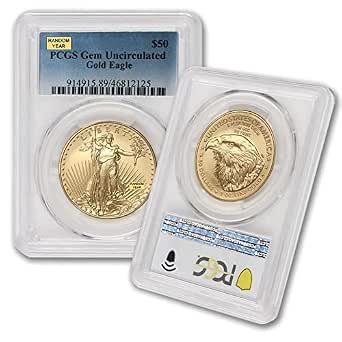
American Gold Eagle Coin, 1 oz, Random Year (1986–Present), PCGS Gem Uncirculated
For a buyer prioritizing a full troy ounce of gold in a recognized U.S. coin, this American Gold Eagle is the strongest fit in this group. Its PCGS Gem Uncirculated grade adds a professional condition assessment, while the 91.67% gold alloy gives the coin more durability than a pure-gold coin. Compared with the 1/2 oz American Gold Eagle, this choice concentrates more gold in one coin; the smaller option may suit buyers who want more flexibility when selling portions of a holding. The tradeoff is that this is a random-year, random-type purchase: neither the date nor Type 1 or Type 2 design is selectable, and the stock image may not match the coin delivered. Its $50 denomination is face value, not a statement of its gold-market value.
Pros:- Contains 1 troy ounce of gold
- PCGS Gem Uncirculated grading provides a stated condition assessment
- American Gold Eagle design and U.S. $50 denomination
- Random-year range runs from 1986 to the present
Cons:- Year and Type 1 or Type 2 variety are not selectable
- Stock photo may not show the coin received
- The full-ounce format offers less divisibility than the smaller Eagles in this roundup
Best for: Buyers seeking one PCGS-graded, full-troy-ounce American Gold Eagle for a gold-focused collection or holding.
Not ideal for: Buyers who want a specific date or Type 1/Type 2 design, or who prefer smaller increments like the 1/4 oz and 1/10 oz Eagles.
- Gold content:1 troy ounce
- Purity:91.67%
- Denomination:$50
- Grade:Gem Uncirculated
- Grading service:PCGS
- Year:Random year, 1986–present
- Coin variety:Type 1 or Type 2
- Diameter:32.7 mm
Our verdict“Choose this coin if a full ounce and PCGS grading matter more than selecting a particular year or design.”
South African Gold Krugerrand Coin, 1 Troy Ounce, PCGS Gem Uncirculated, Random Year
The Krugerrand suits buyers who want a full troy ounce but would rather hold a coin with South African identity than another American Gold Eagle. Like the one-ounce Eagle, it contains 91.67% gold and carries a PCGS Gem Uncirculated grade, so the main distinction here is coin type and denomination rather than gold weight. Its 1 Rand denomination also sets it apart from the Eagle’s $50 face value, though face value should not be confused with gold content. Compared with the French 20 Francs Rooster, the Krugerrand keeps far more gold in a single coin, but gives up the smaller-unit flexibility of that fractional piece. The date is random and cannot be requested, making this a poor match for date-focused collecting.
Pros:- Contains 1 troy ounce of gold
- PCGS Gem Uncirculated grade is specified
- South African Krugerrand offers a distinct alternative to the American Gold Eagle
- 91.67% gold purity matches the alloy fineness of the full-size Eagle in this roundup
Cons:- Random year means a specific date cannot be requested
- The one-ounce size is less divisible than the fractional coins in this group
- The 1 Rand denomination may be less familiar to buyers focused on U.S. coinage
Best for: Buyers who want a PCGS-graded, one-ounce gold coin from South Africa rather than a U.S. Gold Eagle.
Not ideal for: Collectors seeking a particular year, or buyers who want smaller gold units such as the French 20 Francs Rooster.
- Precious metal weight:1 troy ounce
- Gold purity:91.67%
- Denomination:1 Rand
- Grade:Gem Uncirculated
- Grading service:PCGS
- Year:Random year
- Diameter:32.8 mm
- Thickness:2.84 mm
Our verdict“Pick the Krugerrand if you want a graded full-ounce coin and prefer its South African identity to the American Eagle.”
French Gold Rooster 20 Francs Coin, Random Year 1899–1914, Brilliant Uncirculated
This French 20 Francs Rooster stands apart from the modern Eagles and Krugerrand through its historic date range and compact 0.1867 troy ounce of gold. That smaller gold content can make it easier to hold as one part of a mixed collection, while its 21 mm size is notably less substantial than the full-ounce coins. Unlike the American Gold Eagles in this lineup, it is not described as PCGS graded; it is sold as Brilliant Uncirculated with a certificate of authenticity. That distinction matters to buyers who specifically want third-party grading. The random year and indicative stock image also limit control over the exact coin. This is a better match for someone drawn to historic European coinage than for a buyer seeking a standardized modern bullion format.
Pros:- Contains 0.1867 troy ounces of gold in a compact coin
- Historic French 20 Francs Rooster type with dates from 1899–1914
- Listed as Brilliant Uncirculated
- Includes a certificate of authenticity
Cons:- Contains substantially less gold than the one-ounce Eagle and Krugerrand
- No PCGS grading is specified, unlike several Eagles and the Krugerrand
- Year and actual appearance vary, with the stock image serving as an example only
Best for: Collectors who want a small amount of gold in a historic French coin and value its 1899–1914 date range.
Not ideal for: Buyers who prioritize a full-ounce bullion coin, PCGS grading, or a guaranteed specific year and appearance.
- Denomination:20 Francs
- Gold content:0.1867 troy ounces
- Purity:90% gold
- Year:Random year, 1899–1914
- Grade:Brilliant Uncirculated
- Diameter:21 mm
- Thickness:1.4 mm
- Included:Certificate of authenticity
Our verdict“Choose this Rooster for historic fractional gold, not as a substitute for a graded, full-ounce bullion coin.”
American Gold Eagle 1/10 oz Bullion Coin with Certificate of Authenticity
At 1/10 troy ounce, this Gold Eagle offers the smallest gold holding among the American Eagles reviewed here, making it a practical choice for buyers who want to start with a modest coin rather than a quarter-ounce or full-ounce piece. It carries a $5 U.S. denomination and includes a certificate of authenticity, but its condition is listed as Uncirculated rather than PCGS Gem Uncirculated. That makes it less suited to buyers who want third-party grading than the 1/4 oz and 1 oz Eagles in this group. The year is random, and the reverse design changes by year, so it is not a reliable pick for someone pursuing a particular version. Compared with the French 20 Francs Rooster, it contains less gold but has a modern U.S. Mint identity.
Pros:- Small 1/10 troy ounce gold content offers a lower-weight format
- U.S. Mint Gold Eagle design with a $5 denomination
- Certificate of authenticity included
- Uncirculated condition is specified
Cons:- Contains less gold than the 1/4 oz and 1 oz Eagles in this roundup
- No PCGS grading is specified
- Random year means the reverse design varies and cannot be selected
Best for: First-time gold coin buyers or collectors who want a small American Gold Eagle and an included authenticity certificate.
Not ideal for: Buyers who want PCGS grading, more gold per coin, or control over the year and reverse design.
- Gold content:1/10 troy ounce
- Composition:91.67% gold
- Total item weight:2.86 g
- Denomination:$5
- Mint:U.S. Mint
- Year:Random year, 1986–present
- Condition:Uncirculated
- Certificate:Certificate of authenticity included
Our verdict“This is the sensible Eagle for buyers seeking a small gold unit and certificate, provided PCGS grading is not a priority.”
1/4 oz American Gold Eagle Coin, Random Year (1986–Present), $10 Denomination, PCGS Gem Uncirculated
The quarter-ounce Eagle balances a meaningful gold holding with more divisibility than the full-ounce American Gold Eagle. Its PCGS Gem Uncirculated grade gives it an advantage over the 1/10 oz Eagle, which includes a certificate but does not specify third-party grading. At 1/4 troy ounce, this coin also contains more gold than the French 20 Francs Rooster’s 0.1867 troy ounces, while retaining the familiar U.S. Eagle design and $10 denomination. The compromise is limited choice: the year and Type 1 or Type 2 variety are random, and the stock image may not depict the delivered coin. Buyers seeking the most gold in one piece should compare it with the one-ounce Eagle; this format is better for those who prefer to split a holding across smaller coins.
Pros:- Contains 1/4 troy ounce of gold
- PCGS Gem Uncirculated grade is specified
- Fractional size offers more divisibility than the one-ounce Eagle
- American Gold Eagle design with a $10 denomination
Cons:- Year and Type 1 or Type 2 variety are selected at random
- Stock image is indicative and may differ from the coin received
- Contains less gold than the one-ounce Eagle
Best for: Buyers who want a PCGS-graded American Gold Eagle in a fractional size between the 1/10 oz and full-ounce formats.
Not ideal for: Buyers who need a specific year or coin type, or who want the highest gold content in a single coin.
- Gold content:1/4 troy ounce
- Metal content:7.08 g
- Purity:.9167 fine gold (22 karat)
- Denomination:$10
- Grade:Gem Uncirculated
- Grading service:PCGS
- Year:Random year, 1986–present
- Diameter:22 mm
Our verdict“Choose this quarter-ounce Eagle if you want PCGS grading and a divisible U.S. gold coin without stepping down to 1/10 ounce.”
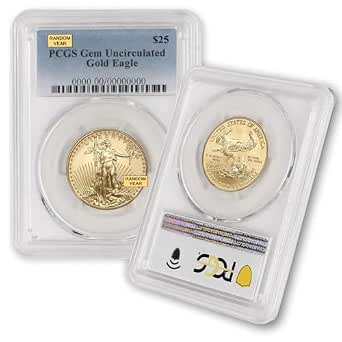
1/2 oz American Gold Eagle Coin, Random Year, PCGS Gem Uncirculated
I’d choose this half-ounce Gold Eagle for a buyer who wants a substantial bullion holding without moving up to the one-ounce coin. Its PCGS Gem Uncirculated grade adds third-party condition verification, unlike the 2026 1/10 oz Gold Eagle in this lineup, whose grading is provided by the seller. The coin’s U.S. legal-tender status and familiar Eagle design also make it a recognizable alternative to the 1-gram Canadian Maple Leaf, though it contains less-pure 22-karat gold rather than .9999 fine gold. The tradeoff is flexibility: the random year and Type 1 or Type 2 design mean you cannot select a particular issue, and the stock photo may not match the coin delivered. Its sealed holder protects the graded coin but offers less direct handling than an unencapsulated piece.
Pros:- Contains 0.5 troy ounce of gold, more than the 1/10-ounce Eagle and 1-gram Maple Leaf
- PCGS Gem Uncirculated grade provides third-party condition assessment
- U.S. legal-tender status and widely recognized American Gold Eagle design
- Sealed holder helps protect the graded coin
Cons:- Random year and Type 1 or Type 2 design prevent issue selection
- 22-karat purity is lower than the Canadian Maple Leaf’s .9999 fine gold
- Stock photo means the delivered coin may differ in appearance
Best for: Buyers seeking a recognized U.S. bullion coin with a meaningful half-ounce gold holding and independent grading.
Not ideal for: Collectors who need a specific year or design, or buyers who prioritize .9999-pure gold over the Eagle’s 22-karat alloy.
- Gold content:0.5 troy ounce
- Purity:91.67% (22 karat)
- Diameter:27 mm
- Thickness:2.24 mm
- Denomination:$25
- Year:Random year, 1986–present
- Condition and grading:Gem Uncirculated, PCGS
- Design:Type 1 or Type 2
Our verdict“Choose this graded half-ounce Eagle if you want a substantial, recognizable U.S. gold coin and can accept a randomly selected year and design.”
2014–Present 1 Gram .9999 Gold Canadian Maple Leaf Coin, 50¢, Brilliant Uncirculated
This 1-gram Canadian Maple Leaf is the most compact way in this group to own a .9999-fine gold coin. Its 24-karat purity distinguishes it from the 22-karat American Gold Eagles, while the serialized blister card and certificate give the buyer identification and authenticity documentation in the package. Compared with the 2026 1/10 oz Gold Eagle, it contains much less gold, but its small unit size may suit someone building a position in incremental steps. That convenience comes with a clear compromise: the 8 mm coin is very small, so its design is harder to appreciate and it may feel less substantial as a jewelry-oriented keepsake. The year is random, and the card limits direct handling; this is better for compact bullion ownership than for buyers seeking a larger display coin.
Pros:- Contains .9999-fine, 24-karat gold
- Serialized blister card and certificate of authenticity provide identifying documentation
- Compact 1-gram format supports small-step accumulation
- Brilliant Uncirculated condition
Cons:- Contains far less gold than the 1/10-ounce and half-ounce Gold Eagles
- 8 mm diameter makes the coin small and its design difficult to view
- Random year and blister packaging limit issue choice and direct handling
Best for: First-time or incremental gold buyers who want a very small, .9999-fine Royal Canadian Mint coin with serialized packaging and a certificate.
Not ideal for: Buyers who want a substantial gold holding, a larger coin to display, or the freedom to handle the coin outside its packaging.
- Gold weight:1 gram (0.0322 troy ounce)
- Purity:.9999 fine (24 karat; 99.99%)
- Diameter:8 mm
- Denomination:50¢
- Condition:Brilliant Uncirculated
- Year:Random year, 2014–present
- Mint:Royal Canadian Mint
- Packaging:Divisible serialized blister card with certificate of authenticity
Our verdict“Pick this Maple Leaf if compact size and .9999 purity matter more to you than gold quantity or a larger, easier-to-view coin.”
2026 American Gold Eagle 1/10 oz Bullion Coin with Certificate of Authenticity
The 2026 1/10 oz Gold Eagle suits buyers who want a specific current-year issue in a smaller U.S. coin format. Unlike the random-year half-ounce Eagle, its date is fixed, and its $5 legal-tender denomination and classic Liberty-and-eagle imagery give it a familiar American profile. It also offers a larger gold holding than the 1-gram Canadian Maple Leaf, although the Maple Leaf is purer at .9999 fine. This Eagle is 91.67% gold, with the stated gold weight set at 1/10 troy ounce; its compact size makes it a lower-quantity choice than the half-ounce option. The main documentation caveat is that grading comes from the seller, not an independent grading service like PCGS, so buyers who value third-party condition assessment may prefer the half-ounce coin.
Pros:- Fixed 2026 year avoids the random-date issue of the half-ounce Eagle
- Contains 1/10 troy ounce of gold
- U.S. Mint coin with $5 legal-tender denomination and recognizable American imagery
- Includes a certificate of authenticity
Cons:- Seller provides the grading rather than an independent grading service
- Contains less gold than the half-ounce American Gold Eagle
- 91.67% purity is below the Canadian Maple Leaf’s .9999 fine
Best for: Buyers who want a dated 2026 American Gold Eagle with a fractional gold content and a certificate of authenticity.
Not ideal for: Buyers seeking PCGS or other independent grading, .9999-fine gold, or a larger gold holding per coin.
- Year:2026
- Gold weight:1/10 troy ounce
- Gold purity:91.67% (0.9167 fine)
- Total item weight:2.86 g
- Denomination:$5
- Mint:U.S. Mint
- Grade:Mint State; grading provided by seller
- Finish and quantity:Polished gold; quantity 1
Our verdict“Choose this coin for a dated fractional American Gold Eagle, but favor the PCGS half-ounce version if independent grading matters more than the specific year.”

How We Picked
I ranked these coins around the needs implied by gold ownership with jewelry-like design appeal: recognizable designs, stated gold content, practical sizing, and the way each option fits a buyer’s likely holding strategy. I also weighed whether the product is a modern bullion coin, a fractional-size purchase, or a historic issue, since those distinctions affect how easily a buyer can compare pieces and plan future purchases. The list does not assume that a certificate, grading label, or older date automatically adds investment value.
The 1 oz American Gold Eagle leads because it balances substantial gold content and broad familiarity. The Krugerrand follows as a compelling full-ounce alternative, while the Rooster earns a distinct place for buyers seeking a historic coin rather than a modern bullion issue. Fractional Eagles rank by how they serve buyers who want smaller units; the Maple Leaf stands out for its one-gram size and stated .9999 purity. The two 1/10 oz Eagles are separated by the listed date range and certificate, not by an assumption that one has greater gold value. Coin condition, authenticity, seller documentation, and the premium over the gold content still need independent checking before purchase.
| gold jewelry investment coin | Grade |
|---|---|
| American Gold Eagle Coin | Gem Uncirculated |
| South African Gold Krugerrand | Gem Uncirculated |
| French Gold Rooster 20 Francs | Brilliant Uncirculated |
| American Gold Eagle 1/10 oz Bu | — |
| 1/4 oz American Gold Eagle Coi | Gem Uncirculated |
| 1/2 oz American Gold Eagle Coi | — |
| 2014–Present 1 Gram .9999 Gold | — |
| 2026 American Gold Eagle 1/10 | Mint State; grading provided by seller |
Factors to Consider When Choosing Gold Jewelry Investment Coins
Before choosing among these gold jewelry investment coins, decide what you want the coin to do. A piece bought mainly for gold exposure calls for a different comparison than one bought for its design, age, or gift appeal. The following factors help separate metal value from presentation and reduce the chance of paying for features that do not matter to you.
Compare Gold Content, Not Just Coin Size
A coin’s physical diameter does not tell you how much gold it contains, so start with the stated weight and fineness. This matters especially when comparing a one-gram Maple Leaf, fractional Eagles, and full-ounce coins. Some coin weights describe the total alloy weight rather than pure gold content, so check the issuing mint’s specifications instead of inferring from the label. A smaller coin can be easier to buy in stages, but the premium per unit of gold may differ from that of a larger coin. Compare like with like by calculating the gold content and asking the seller to explain any premium. Avoid treating face value as a measure of the coin’s metal value.
Choose a Size That Fits Your Exit Plan
Think about how you might sell or exchange the coin before deciding between one ounce and fractional sizes. Smaller pieces may let you sell part of a holding instead of liquidating a large coin, but each piece can carry its own transaction costs and premium. A one-ounce coin consolidates more gold into a single item, which can simplify storage but leaves less flexibility if you need to sell only a portion. Buyers building a holding over time may prefer repeatable fractional sizes, while someone making a single long-term purchase may prefer fewer, larger pieces. Ask prospective dealers which formats they commonly buy back and what documentation they expect. Do not assume every shop values every coin identically.
Separate Bullion Value From Collectible Appeal
Modern bullion coins and historic coins serve overlapping but different purposes. A historic issue such as the French Gold Rooster may appeal for its period design and coinage history, while modern Eagles and Maple Leafs are easier to compare by published weight and specifications. Collectible demand can add value, but it can also make valuation less straightforward than checking gold content alone. A random-year listing does not let you choose a specific date, and a graded condition label does not guarantee that a future buyer will pay an added amount for the grade. If you mainly want exposure to gold, avoid paying a collectible premium unless you can explain what supports it. If design and history matter to you, treat that appeal as a separate part of the purchase decision.
Check Purity, Alloy, and the Meaning of the Label
Coins with different fineness can contain similar amounts of gold if their total weights differ, so purity alone is not a complete comparison. For example, the Maple Leaf is listed as .9999 fine, while American Gold Eagles use a different composition; compare each coin’s stated gold content rather than assuming the purer coin always holds more gold. Alloy choices can affect durability and color, which may matter to someone drawn to jewelry-like appearance or frequent handling. Confirm specifications from a reliable mint or dealer source, especially when a listing uses broad terms such as “gold coin.” Never rely on a photograph to establish composition. For a purchase focused on investment, the stated fine-gold amount should stay central to your comparison.
Treat Grading and Certificates as Supporting Evidence
A PCGS grade or certificate can help describe a coin or support its documentation, but neither replaces checking the seller, product details, and authenticity safeguards. “Gem Uncirculated” describes a condition category, not a promise of investment performance or a guaranteed resale premium. A certificate of authenticity is useful only when it can be linked clearly to the specific coin and issuer; it does not establish that the coin is a better value than an otherwise comparable issue. Compare packaging and documentation with the actual coin specifications, and retain records after purchase. For random-year products, confirm whether the year is selected by the seller. Pay extra for grading or paperwork only when those features serve your collecting or resale priorities.
Plan Storage, Insurance, and Selling Costs
Owning physical gold includes practical costs that are easy to overlook when comparing listings. Decide whether the coin will be kept in a home safe, a bank box, or another secure location, and check any insurance conditions that apply. Small coins are easy to store discreetly, but their size also makes careful handling and secure packaging important. Before buying, ask dealers about buyback procedures, identity or condition requirements, and how they determine an offer. Keep invoices and certificates together, since missing records can complicate later verification. The purchase is only part of the decision; safe custody and a realistic resale route matter too.
Frequently Asked Questions
Should I buy one 1 oz coin or several fractional American Gold Eagles?
Choose a one-ounce coin if you prefer to hold more gold in a single piece and do not expect to sell only a small portion later. Fractional Eagles offer more control over how much you might sell at once, which can suit staged buying or a gift purchase. The tradeoff is that smaller formats may carry a higher premium per unit of gold, so compare the seller’s full terms rather than only the coin’s size. Consider whether local dealers readily handle the sizes you want. Your planned purchase and sale pattern should guide the choice more than the denomination alone.
Is the 1 gram Maple Leaf a better investment than a 1/10 oz Gold Eagle?
Neither is automatically better: the Maple Leaf is listed at one gram with .9999 purity, while the Eagle is a fractional coin with a different gold content and composition. Compare each item’s fine-gold amount, premium, authenticity documentation, and likely resale options before choosing. The one-gram format can suit a buyer who wants a very small unit, while a 1/10 oz coin holds more gold in one piece. A coin’s purity figure alone does not determine its value or ease of resale. Check the exact specifications and seller terms for the specific listing.
Does a PCGS Gem Uncirculated label mean I should pay more?
Not by itself. A grading label describes condition under a grading system, but it does not guarantee a higher future selling price or make the gold content more valuable. An added premium may make sense to a collector who values the documented condition and presentation. For a buyer focused mainly on bullion, compare the graded coin with an equivalent ungraded option by gold content, total premium, and dealer buyback practices. Ask whether the specific grade changes the dealer’s offer before paying extra. Treat grading as a feature to verify, not as a promise of return.
How should I compare a historic French Gold Rooster with modern bullion coins?
Start by separating the Rooster’s historic and collectible appeal from its gold content. Check the coin’s specifications, condition, authenticity, and seller documentation, then compare its premium with a modern bullion coin containing a similar amount of gold. Historic issues may attract buyers for reasons beyond metal value, but that can make resale pricing less directly tied to bullion benchmarks. A modern Eagle or Krugerrand may be simpler to compare using familiar bullion specifications. Choose the Rooster when its design and history are part of your goal, not just because it is older.
Do the two listed 1/10 oz American Gold Eagles differ enough to choose one over the other?
The listed distinction is that one is a random-year 1/10 oz Eagle with a certificate of authenticity, while the other specifies a 2026 issue and also lists a certificate. Both are fractional American Gold Eagles, so compare their exact gold specifications, condition, packaging, and seller terms rather than assuming the newer date is inherently more valuable. A buyer who wants a specific year may prefer the 2026 listing; someone indifferent to date may find random-year availability more suitable. Ask whether the coin shown is the coin delivered and what the certificate identifies. Any premium for a date or packaging feature should match your collecting priorities.
Conclusion
For most buyers seeking a recognizable, substantial coin, I recommend the 1 oz American Gold Eagle as best overall; the 1 oz Krugerrand is my alternative for a full-ounce bullion focus. The French Gold Rooster is best for historic character, while the fractional Eagles are the best fit for beginners who want to buy in smaller units and learn how coin premiums compare. The 1 gram Maple Leaf suits buyers who specifically want a very small coin with .9999 stated purity. For a premium-oriented purchase, choose a graded Eagle only if its condition documentation matters to you, not just because it carries a label. Whichever option you favor, compare fine-gold content, seller terms, authenticity support, and resale routes before placing an order.