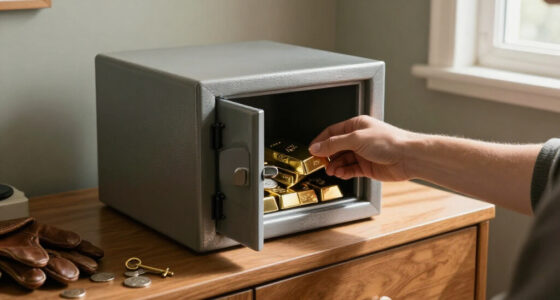

Precious metals investment kits can package coins or bars in a convenient purchase, but the word “kit” does not tell you whether the contents fit your goals. The central choice is between a diversified kit, which divides the purchase among metals such as gold, silver, platinum, or palladium, and a single-metal kit, which concentrates the purchase in one. Diversification can reduce reliance on one metal’s price movement, while concentration makes the position simpler and may avoid paying for metals you do not want. Neither format guarantees a return, and the dealer’s premium, product selection, and buyback terms matter as much as the packaging. Choose a diversified kit if you want a ready-made spread and understand its extra complexity; choose a single-metal kit if you have a clear preference and want to control exactly what you own.

Get home office essentials delivered free with Prime
- Fast, free delivery on millions of items
- Prime Video, Amazon Music and more included
- Member-only deals all year

Precious Metal Investing: A Beginner’s Guide to Investing in Gold, Silver, and Rare Metals for Long-Term Wealth
- ✔ Product type: Investing guide; specific format not provided
- ✔ Primary subject: Precious metal investing
- ✔ Metals named: Gold, silver, and rare metals

The Bullion Coin Bible: A Complete Guide to Investing in and Collecting Gold and Silver Coins
- ✔ Product type: Coin investing and collecting guide; specific format not provided
- ✔ Primary subject: Bullion coins
- ✔ Metals named: Gold and silver
At a Glance
| Criteria | Diversified precious metals investment kits | Single-metal investment kits | Winner |
|---|---|---|---|
| Exposure | Multiple metals in one purchase | One selected metal | Depends |
| Diversification | Spread across metals, though still concentrated in physical commodities | No spread across metals | A |
| Pricing and premiums | May include different premiums and make per-item comparison harder | Easier to compare like-for-like products; premium still varies by item and dealer | B |
| Flexibility | Useful if you want several metals at once; proportions may be preset | Direct control over product type and quantity within that metal | B |
| Storage and recordkeeping | More types of items to identify and track | Fewer product types to track | B |
| Simplicity | Convenient package, with more components to understand | Straightforward to understand and evaluate | B |
Precious Metal Investing: A Beginner’s Guide to Investing in Gold, Silver, and Rare Metals for Long-Term Wealth
For a reader still deciding what precious metals investing involves, Precious Metal Investing has the broader stated remit of these two guides. Its title names gold, silver, and rare metals, while also signaling a beginner audience and a long-term wealth focus. Compared with The Bullion Coin Bible, which concentrates on coins, this option appears better suited to someone who wants to begin with the categories of metals before narrowing into a particular form of ownership. That makes it our best overall pick on subject coverage, not a claim that its contents have been independently verified.The breadth is also its main limitation. The listing gives no chapter outline or explanation of what “rare metals” means in practice, so we cannot tell whether it treats each metal in depth or surveys them briefly. It also provides no information about format, worksheets, or other materials. Buyers who already know they want bullion coins may find the coin-specific title more directly relevant. We would choose this guide for its multi-metal beginner scope, while recognizing that its actual depth and included materials are unspecified.
Pros:
- Covers gold, silver, and rare metals in its stated subject.
- Explicitly aimed at beginner investors.
- Its broad scope makes it the more general starting point in this comparison.
Cons:
- The available description gives no specific topics or chapter details.
- Format and any included learning materials are not specified.
- Its broad subject may be less targeted than a bullion coin guide for coin-focused readers.
Best for: New investors who want a stated beginner-oriented introduction spanning gold, silver, and other rare metals.
Not ideal for: Readers seeking a documented physical kit, a detailed coin collecting manual, or verified information about chapters and investing tools.
Bottom line: Choose this as the broader beginner entry point if you want to explore several precious metals, but check the full listing for content and format details before expecting a practical kit.
“Choose this as the broader beginner entry point if you want to explore several precious metals, but check the full listing for content and format details before expecting a practical kit.”
The Bullion Coin Bible: A Complete Guide to Investing in and Collecting Gold and Silver Coins
The Bullion Coin Bible is the more specialized choice: its stated subject is investing in and collecting gold and silver bullion coins. That focus gives it a clear role alongside the broader Precious Metal Investing. If your questions already center on coins, a guide framed around both investing and collecting may be a closer match than a title covering multiple metals generally. Its scope may also appeal to readers who want to consider bullion coins as collectibles as well as investment items.Specialization comes with a narrower reach. The title does not identify rare metals or offer a wider beginner overview, so readers comparing metal categories may be better served by the first book. The available description also provides no table of contents, methods, or format details. Although “complete guide” appears in the title, the listing information supplied here is not enough to assess its completeness or verify what coin topics it covers. We see its value in clear coin-focused positioning, with the caveat that the scope and practical detail remain unconfirmed.
Pros:
- Explicitly focuses on gold and silver bullion coins.
- Connects investing with collecting in its stated scope.
- Offers a more specialized alternative to a broad multi-metal introduction.
Cons:
- Does not indicate coverage of rare metals or a wider metals overview.
- No contents, format, or practical learning tools are detailed in the supplied information.
- The title’s “complete guide” claim cannot be assessed from the available description.
Best for: Readers primarily interested in gold and silver bullion coins as both investment and collecting subjects.
Not ideal for: Beginners who want a broad overview of several precious metals, or buyers who need confirmed physical components and detailed contents.
Bottom line: Pick this when bullion coins are your specific learning goal, while treating its depth and format as unknown until you review the full product listing.
“Pick this when bullion coins are your specific learning goal, while treating its depth and format as unknown until you review the full product listing.”
As an Amazon Associate we earn from qualifying purchases.
Key Differences
The biggest difference is how much decision-making happens before and after purchase. A diversified kit chooses a mix for you, which can be useful for someone who wants exposure to several metals without assembling separate orders. That convenience comes with a tradeoff: the mix may not match your preferred allocation, and the total price can obscure the premium attached to each coin or bar. A single-metal kit makes the exposure plain. You decide whether the chosen metal suits your plan, then compare similar products and quantities.
Diversification can soften the effect of one metal performing poorly relative to another, but it does not remove market risk. The metals may all fall in value, and physical products can be difficult or costly to sell quickly. A mixed kit also introduces more product types, potential resale channels, and storage details. A single-metal kit avoids that administrative spread, but its results depend more heavily on the price path of one metal. Neither choice should be treated as a guaranteed hedge or as a substitute for a broader financial plan.
Value is determined less by the kit label than by the contents and terms. Compare the actual metal weight and product types, the price against a current spot reference, all premiums and fees, shipping and storage costs, and the dealer’s buyback policy. Paying extra for a diversified package makes sense only when its selection and convenience are worth the added cost and complexity to you. If the dealer will not clearly itemize what you receive, the package is hard to judge and may not be a good value.
Detailed Comparison
Exposure (major difference)
A diversified kit spreads the purchase over several metals; a single-metal kit ties it to one. There is no universal winner because the right exposure depends on the buyer’s reason for investing. The difference is major: a concentrated position can benefit more when its metal rises, but it can also suffer more when that metal falls. A mix reduces dependence on one metal’s relative performance without preventing losses across the whole purchase.
Diversification (Diversified precious metals investment kits wins — moderate)
The diversified kit wins this criterion because it includes more than one metal. The gap is moderate: metals can behave differently, but they remain physical commodities with market, liquidity, and dealer risks. A multi-metal package is not broad diversification across asset classes. Buyers should not assume that a mix makes the investment safe or guarantees smoother returns.
A single-metal kit is usually easier to price-check because buyers can compare the same type of coin or bar across dealers. A diversified kit may contain items with different premiums, making the total package less transparent unless each component is listed. This is a moderate practical advantage for B, not a promise that single-metal products are cheaper. Compare final delivered cost and potential resale terms before deciding.
Flexibility (Single-metal investment kits wins — moderate)
Single-metal kits win for control: you choose the metal and can decide how much of the budget goes to each product. Diversified kits can save the effort of placing several orders, but a preset allocation may include a metal you would not select yourself. The gap is moderate and matters most to buyers with a target allocation. Check whether the kit allows substitutions or adjustable quantities.
Storage and recordkeeping (Single-metal investment kits wins — minor)
With one metal and often fewer product types, a single-metal kit is easier to inventory and document. A diversified package can require tracking several metals, weights, and product designs. The gap is minor for small purchases kept securely with clear receipts, but it grows as the collection expands or is stored through a third party. Neither format removes the need to keep purchase records and confirm insurance or storage terms.
Simplicity (Single-metal investment kits wins — moderate)
A single-metal kit is simpler to understand because its market exposure is direct and its products are easier to compare like for like. A diversified kit offers a convenient bundle but asks the buyer to evaluate multiple contents and pricing components. The difference is moderate: the package can simplify ordering while making valuation and resale planning more involved. Choose based on whether you value one-step purchasing or a straightforward position.
Diversified precious metals investment kits: Pros and Cons
Pros:
- Provides exposure to multiple metals in one purchase
- Can reduce dependence on one metal’s relative price movement
- Convenient for buyers who want a preassembled mix
Cons:
- Preset proportions may not suit the buyer
- Multiple product premiums can make total pricing harder to evaluate
- More product types add tracking and resale complexity
Single-metal investment kits: Pros and Cons
Pros:
- Clear, concentrated exposure to a chosen metal
- Easier to compare similar products and dealer prices
- Simpler storage inventory and recordkeeping
Cons:
- No diversification across metals
- The purchase depends more heavily on one metal’s performance
- Buyer must decide which metal and products fit the intended purpose
Who Should Choose What
Choose Diversified precious metals investment kits if:
- You want several metals in one order and accept the kit’s stated allocation.
- You are comfortable checking the premium and resale terms for every component.
- You prefer a ready-made mix over placing separate purchases.
Choose Single-metal investment kits if:
- You have a clear reason to favor one metal and want direct exposure.
- You want to compare identical products and control quantities closely.
- You value a simpler inventory and are willing to accept concentrated market risk.
Skip both if: Skip both if you need quick access to your money, cannot verify the full cost and contents, or are treating precious metals as a guaranteed return or a replacement for a diversified financial plan.
Value for Money
Pay more for a diversified kit only when its contents match an allocation you would choose yourself and the convenience is worth the premium. Request an itemized list, compare each product with similar items from other sellers, and include shipping, storage, taxes where applicable, and likely resale costs in the comparison. A bundle is not automatically a bargain because it contains several metals. If its component prices are unclear, you cannot tell whether convenience is costing too much.
For many first-time buyers, a fairly priced single-metal kit can offer better value because it is easier to inspect, compare, and understand. That does not mean it is safer: concentration increases exposure to that metal’s price movements. A diversified kit may be worth its additional cost for someone who deliberately wants several metals and would otherwise buy them separately. Pay for the allocation you want, not for the word “investment” or a claim that the package is rare or guaranteed to appreciate.
Final Verdict
For most buyers who already know which metal they want, the single-metal kit is the clearer choice: it makes exposure, product comparison, and recordkeeping easier. Choose the diversified kit when a mix is part of your plan, its exact contents are disclosed, and the extra convenience justifies its total price. The biggest deciding factor is whether you want control over a focused position or are comfortable accepting a preselected spread. If you cannot verify the itemized cost and a realistic resale route, skip the offer regardless of format.
Frequently Asked Questions
Does a diversified precious metals kit reduce investment risk?
It spreads exposure among metals, so one metal’s relative decline may matter less than in a single-metal purchase. It does not prevent losses: several metals can decline together, and physical products have premiums, resale, and liquidity risks.
Are precious metals investment kits cheaper than buying items separately?
Not necessarily. Compare the itemized price of each coin or bar with equivalent products, then add shipping, storage, and other fees. A bundled price alone does not show whether the contents are good value.
Which kit is better for a first-time buyer?
A single-metal kit is often easier to evaluate because it has a clear exposure and fewer product types. A first-time buyer who wants several metals can still choose a diversified kit, but should check every component and avoid relying on sales claims about guaranteed growth.
Can I resell the metals in a kit later?
Possibly, but resale depends on the product, dealer, market conditions, and transaction costs. Ask how the seller handles buybacks, whether it will repurchase every included item, and what fees or price differences may apply.