
TL;DR
Christine Lagarde told the European Parliament’s Economic and Monetary Affairs Committee that the ECB raised its three key interest rates by 25 basis points this month as energy prices lifted the inflation outlook. She also said artificial intelligence could raise productivity but its effects on jobs, investment and inflation remain uncertain.
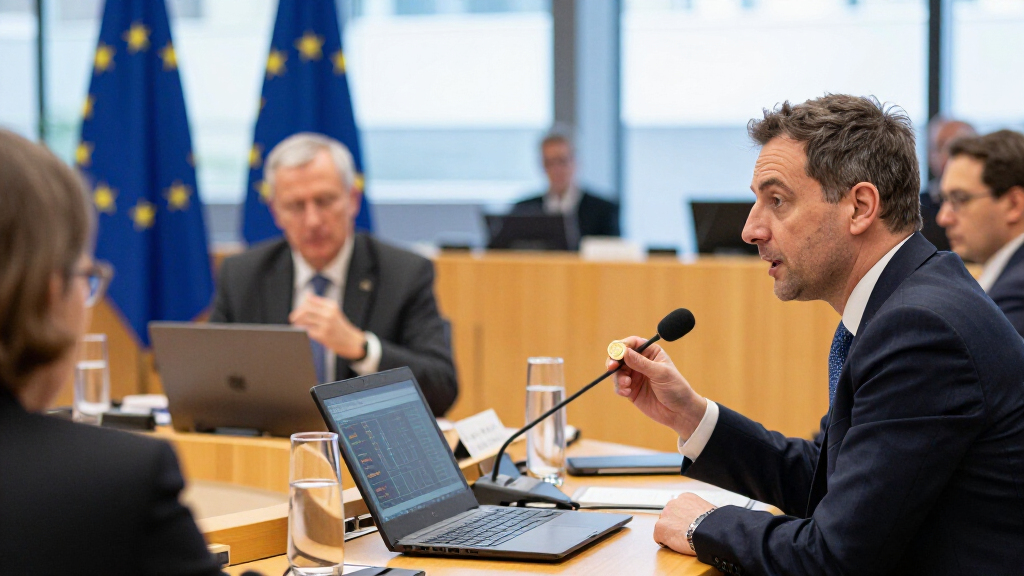
European Central Bank President Christine Lagarde told the European Parliament’s Economic and Monetary Affairs Committee on September 28 that the ECB had raised its three key interest rates by 25 basis points earlier in the month, citing a higher inflation outlook driven mainly by energy prices. She also warned that artificial intelligence could reshape Europe’s economy, while its effects on productivity, employment and inflation remain uncertain.
Lagarde said euro area annual headline inflation rose to 3.2% in August, from 2.9% in July, as energy inflation climbed to 14.3%. Inflation excluding food and energy edged down to 2.4%, while food inflation also eased. She said wage data did not yet show a material response to the energy shock: compensation per employee grew by 3.3% in the second quarter, down from 3.6% in the first.
The ECB’s September projections put average headline inflation at 3.0% in 2026, 2.5% in 2027 and 2.1% in 2028. The bank expects euro area growth of 0.9% this year, followed by 1.4% in 2027 and 1.5% in 2028. Lagarde described the economy as resilient, citing second-quarter growth and a July unemployment rate of 6.4%, while noting that employment and labour-force growth were slowing.
She said the ECB weighs the inflation outlook, underlying inflation and how monetary policy reaches borrowing costs and economic activity. The bank does not react automatically to an energy-price jump, she said, but responds to risks that higher costs become embedded in inflation. Lagarde said there was not yet evidence of energy prices feeding into higher wages. Long-term interest rates had risen since the previous policy meeting, she added, which could weigh on growth.
Rates, Energy and Inflation Risks
The rate increase reflects a balancing act for the ECB: energy prices have pushed inflation higher, but the bank has not seen clear evidence that the shock is spreading into wages. If energy costs continue to feed through to other prices, inflation could remain higher for longer; if higher borrowing costs weigh on activity, growth could weaken. Lagarde described the ECB’s approach as a measured response to a shock too large to ignore.
The discussion also matters because AI investment and adoption may influence the same economic measures the ECB monitors. Higher productivity could lower costs over time, while investment and changes in labour demand may affect output, incomes and prices. Lagarde said these effects are not yet settled, leaving policymakers to assess them as they develop.
Europe’s AI Investment Challenge
Lagarde said firms were set to devote around 10% of total investment to AI in 2026, and AI-related borrowing already represented roughly a quarter of credit growth to firms. An ECB survey found that by late 2025, 38% of euro area firms reported at least moderate AI use, but only 7% said their use was significant. The figures describe different measures: planned investment, lending growth and reported adoption.
She said AI could help businesses produce more and, if productivity rises, reduce costs over time. But broader adoption requires computing capacity, data centres, energy, process changes and employee training. Lagarde pointed to European initiatives, including InvestAI and the Scaleup Europe Fund, as ways to mobilise investment. She said the EU’s planned €30 billion for AI gigafactories was a start, while European AI investment still lagged behind that of the United States.
For the ECB, the hearing was part of its regular dialogue with the Parliament. Lagarde’s remarks joined two issues on the economic outlook: the immediate effects of an energy shock and the longer-term uncertainty surrounding AI. The ECB’s projections provide a baseline, but the speech stressed that risks around both growth and inflation remain high.
“We do not react to energy prices, we react if we see risks of higher energy prices becoming embedded in inflation.”
— Christine Lagarde, ECB president
Open Questions on Jobs and Prices
It remains unclear how quickly AI will spread across European businesses, how large its productivity gains will be and how those gains will be distributed. Lagarde said firms that use AI to support research, innovation and new products tend to hire, while those using it primarily to cut labour costs are reducing employment. The longer-term effect across the whole economy is still uncertain.
The energy outlook and its effect on inflation are also developing. Lagarde said wage data had not yet shown a material response, but the speech did not establish how future energy costs or price-setting decisions will affect wages and underlying inflation. The projections are forecasts, not guarantees, and the outlook carries upside risks for inflation and downside risks for growth.
ECB Tracks Inflation and AI
The ECB will continue to assess incoming inflation, wage and growth data against its three stated criteria when setting policy. Lagarde said the bank would closely observe how AI affects productivity, investment, labour markets, financial conditions and inflation. The speech did not announce a new AI policy or specify a timetable for further rate moves.
For Europe’s AI strategy, Lagarde called for more integrated markets, accessible capital, computing power, skilled workers and affordable energy. She also urged wider deployment beyond a small group of technology leaders, with retraining to address skills shortages. The effects of those proposals, and of the ECB’s rate increase, will depend on developments that remain uncertain.
Key Questions
What did Lagarde tell the European Parliament?
She discussed the ECB’s recent 25-basis-point rate increase, the euro area inflation outlook and the uncertain effects of artificial intelligence on the economy.
Why did the ECB raise interest rates?
Lagarde said the decision followed a higher inflation outlook, largely linked to rising energy prices. She said the ECB watches for evidence that energy costs are feeding into wages and other prices.
What did the ECB report about August inflation?
Headline inflation reached 3.2%, up from 2.9% in July. Inflation excluding energy and food was 2.4%, down slightly from the previous month.
What did Lagarde say about AI and employment?
She said AI may complement workers or replace some tasks, and its effects on jobs and income are uncertain. Firms’ hiring patterns appear to differ depending on how they use the technology.
Source: primary