

Bitcoin’s UTXO model tracks unspent outputs, making transactions more private and secure, but it can be complex and less scalable. Ethereum uses an account-based system, storing balances directly, which simplifies transaction processing and smart contract execution but raises transparency and privacy concerns. Understanding these differences reveals how each blockchain handles security, speed, and scalability. Keep exploring if you want to uncover more about how these models shape their ecosystems and functionalities.
Key Takeaways
- Bitcoin uses the UTXO model, tracking unspent outputs, while Ethereum employs an account-based model storing balances directly.
- UTXO enhances privacy and security through transaction traceability; Ethereum’s accounts are more transparent but less private.
- The UTXO system manages multiple unspent outputs, making transaction processing more complex, whereas Ethereum updates account balances instantly.
- UTXO’s structure supports clear ownership transfer and reduces double-spending risks, while Ethereum enables complex smart contracts and token standards.
- The choice of model impacts scalability, transaction speed, privacy, and ecosystem development in Bitcoin and Ethereum.

Bitkey Bitcoin Hardware Wallet – The Most Secure Way to Buy, Store and Manage Bitcoin
BITCOIN EXCLUSIVE: Bitkey is designed from the ground up exclusively for Bitcoin, offering a dedicated hardware wallet solution…
As an affiliate, we earn on qualifying purchases.
As an affiliate, we earn on qualifying purchases.
What Are Bitcoin and Ethereum’s Data Models?

Bitcoin and Ethereum use fundamentally different data models to organize and track their assets. Bitcoin employs the UTXO model, where each transaction consumes unspent outputs, making token fungibility less straightforward. This means that each Bitcoin transaction references specific coins, which can impact privacy and traceability. In contrast, Ethereum uses an account-based model, where each user has a balance stored in an account, similar to traditional banking systems. This model simplifies transaction processing but raises privacy implications because balances are openly accessible. Token fungibility is also affected; Bitcoin’s UTXO model can make coins distinguishable, while Ethereum’s account system treats tokens more uniformly. The simplicity of account-based systems can facilitate easier integration with traditional financial infrastructure, but also introduces different security considerations. Additionally, the design complexity of UTXO models can make certain transaction types more intricate to implement, affecting scalability and flexibility. The security implications of each model influence how resistant they are to various attack vectors. Understanding these differences helps you grasp how each network manages security, privacy, and the fungibility of digital assets. Moreover, the handling of transaction states differs significantly, impacting network performance and user experience.
Ethereum smart contract development kit
As an affiliate, we earn on qualifying purchases.
As an affiliate, we earn on qualifying purchases.
How Does Bitcoin Use UTXOs to Handle Transactions?

Bitcoin handles transactions by referencing unspent transaction outputs (UTXOs) as inputs, which are then spent to create new UTXOs. When you send Bitcoin, you use existing UTXOs as inputs, and the network generates new UTXOs as outputs. This process guarantees clear tracking of ownership and transfer of funds within the system. Additionally, the system’s reliance on UTXOs facilitates sector performance evaluation, ensuring transparency and accuracy in transaction history. The UTXO model’s design also supports privacy considerations, helping to maintain user anonymity during transactions. Furthermore, the UTXO model’s structure makes it easier to implement smart contract functionalities in Bitcoin’s ecosystem.
Transaction Inputs and Outputs
When you make a transaction, the network handles it by referencing specific unspent transaction outputs (UTXOs) rather than account balances. Each UTXO represents a discrete chunk of cryptocurrency you control, which you use as inputs for new transactions. These inputs specify which UTXOs are spent, and the transaction creates new outputs, assigning funds to recipients. This method enhances token privacy since only the UTXOs involved are revealed, not your entire balance. Additionally, the system architecture ensures precise control over funds, but the need to track multiple inputs and outputs can complicate transaction processing, especially as UTXO sets grow larger over time. Managing numerous UTXOs can also lead to increased transaction size, affecting processing fees and speed. Moreover, the UTXO set requires ongoing management and synchronization across the network, which can impact overall scalability. The distributed nature of UTXOs further complicates scaling efforts, as each UTXO must be individually verified and maintained across nodes. Managing numerous UTXOs can increase computational complexity, making transaction validation more resource-intensive. The system ensures precise control over funds, but the need to track multiple inputs and outputs can complicate transaction processing, especially as UTXO sets grow larger over time.
UTXO Creation and Transfer
To handle transactions, the system uses UTXOs as the fundamental units of value, creating a clear record of each coin’s ownership. When you want to spend a UTXO, you sign the transaction with your digital signature, proving you control that output. The transaction then references the UTXOs you’re spending, and new UTXOs are created for the recipients. These new UTXOs are added to the blockchain, maintaining the unspent record. Consensus mechanisms, like proof of work, validate your transaction’s authenticity and ensure everyone agrees on the current UTXO set. This process guarantees transparency and security, as each transfer is cryptographically signed and verified by the network, preventing double-spending and preserving the integrity of the ledger.

Bitcoin & Privacy: How to Protect Your Money, Your Data, & Your Future When Everything You Do Is Being Watched (The Bitcoin Life Series)
As an affiliate, we earn on qualifying purchases.
As an affiliate, we earn on qualifying purchases.
How Does Ethereum Manage Balances With Accounts?

Ethereum manages balances through account state management, where each account has a stored balance. When transactions occur, it updates these balances directly, ensuring accuracy. Additionally, smart contracts store data that can affect balances, adding flexibility to how assets are managed. This system allows for precise balance tracking within the network, supported by its account-based model that differs from other blockchain architectures. Unlike the UTXO model used by Bitcoin, Ethereum’s approach facilitates more complex transaction logic and dynamic contract interactions, making it suitable for diverse decentralized applications. The state management structure ensures real-time updates and a clear overview of each account’s status.
Account State Management
Have you ever wondered how Ethereum keeps track of everyone’s balances? It uses an account-based system where each user has an account with a balance stored directly on the blockchain. This setup simplifies balance management because transactions directly update account states. Unlike UTXO models, Ethereum’s accounts hold not just balances but also additional data like smart contract code and storage. Blockchain privacy remains a concern since all account balances and transaction history are publicly visible, but privacy solutions are evolving. The entire process relies heavily on consensus mechanisms, such as proof of stake, to validate state changes securely. This approach allows Ethereum to seamlessly track balances, run smart contracts, and maintain a transparent, yet open ledger that’s managed through continuous state updates.
Balance Updates Process
When a user initiates a transaction, the network updates their account balance by adjusting the stored value directly in their account state. This process relies on efficient state tracking, where each account’s balance is part of a centralized state database. Data synchronization ensures all nodes have consistent account information after each transaction, keeping the system reliable. In Ethereum, this process is integral to its account model, contrasting with Bitcoin’s UTXO approach.
Smart Contract Storage
How does Ethereum keep track of balances within smart contracts? It uses smart contract storage, where each account maintains a dedicated storage space for its data, including balances. When a transaction occurs, Ethereum updates this storage to reflect the new state, guaranteeing accurate transaction state management. Smart contract storage is a key component that allows contracts to hold and modify data dynamically, enabling complex decentralized applications. Balances are stored as key-value pairs within each account’s storage, allowing quick access and updates during transactions. This system provides a flexible and efficient way to manage balances without relying on external databases. smart contract storage is designed to be tamper-proof and secure, ensuring the integrity of the stored data. Additionally, the use of account-based models simplifies transaction verification and enhances overall network security. The internal state maintained by these models also facilitates efficient transaction processing, which is essential for high-performance blockchain networks. By maintaining this internal state, Ethereum assures consistency, transparency, and security throughout the transaction process. Furthermore, this internal state management supports smart contract automation, enabling developers to create complex logic and interactions within their decentralized applications. This approach also allows Ethereum to implement upgradable contracts, which can adapt over time without losing their stored data.

Polkadot DOT Crypto Blockchain Currency Notebook: Transaction Log Ledger, Air Drop Tracker, Notebook – Journal – Lined Journal – Mint Notebook 6x9x110 Pages
As an affiliate, we earn on qualifying purchases.
As an affiliate, we earn on qualifying purchases.
Pros and Cons of the UTXO Model for Bitcoin

The UTXO (Unspent Transaction Output) model offers several advantages for Bitcoin, but it also has notable drawbacks. One major concern is privacy; since each transaction references specific unspent outputs, it can be easier to trace your activity, raising privacy concerns. Additionally, the model’s design results in higher energy consumption because each transaction requires processing multiple UTXOs and maintaining a full UTXO set, which demands significant computational resources. On the plus side, the UTXO system enhances security and simplifies verification, making it easier to detect double-spending. However, managing multiple UTXOs can complicate transaction handling and increase storage requirements. Overall, while the UTXO model bolsters security, it introduces privacy limitations and energy inefficiencies that users and developers must consider. Vetted
Advantages and Drawbacks of the Ethereum Account System

Unlike the UTXO model, the Ethereum account system streamlines transaction management by assigning each user a single, persistent account that holds their balance and transaction history. This approach simplifies state management, making it easier to track and update balances in real-time. However, it also introduces privacy considerations, as account balances and transaction details are more accessible and transparent. This transparency can make it easier for third parties to analyze user activity, reducing privacy compared to UTXO-based systems. On the plus side, managing accounts is more straightforward, especially for complex operations like smart contracts. Still, this centralized-like structure can be a drawback for users seeking greater privacy and anonymity. Overall, the Ethereum account system offers efficiency but requires balancing transparency with privacy concerns.
How Data Models Affect Transaction Speed and Smart Contracts

Your choice of data model directly impacts transaction speed and the efficiency of executing smart contracts. In the UTXO model, transaction validation involves verifying each unspent output, which can slow down processing as the network grows. This process adds overhead, limiting scalability. Conversely, the account model simplifies validation by updating balances directly, enabling faster transactions and more efficient smart contract execution. Because of this, networks using the account model often achieve higher transaction throughput. However, the UTXO model’s design can offer benefits in security and transparency, though at the cost of speed. Ultimately, your data model choice influences how well the network scales and how quickly transactions and smart contracts are processed. This trade-off shapes the overall performance and user experience of the blockchain.
Which Model Is Better for Scalability and Security?

Choosing between the UTXO and account models hinges on which qualities matter most for your blockchain’s goals. UTXO models, like Bitcoin’s, excel at scalability challenges because they process transactions in parallel and verify unspent outputs efficiently. This structure also offers clear security implications, as each UTXO is independent, reducing the risk of double-spending. Conversely, the account model, used by Ethereum, simplifies complex smart contract interactions and state management but can face scalability hurdles due to global state updates that slow transaction throughput. Security implications vary: UTXO’s transparency and independence make it resilient against certain attacks, while the account model’s complex logic introduces potential vulnerabilities. Ultimately, your choice depends on whether scalability or security considerations weigh more for your blockchain’s intended use.
How Do UTXO and Account Models Shape the Crypto Ecosystem
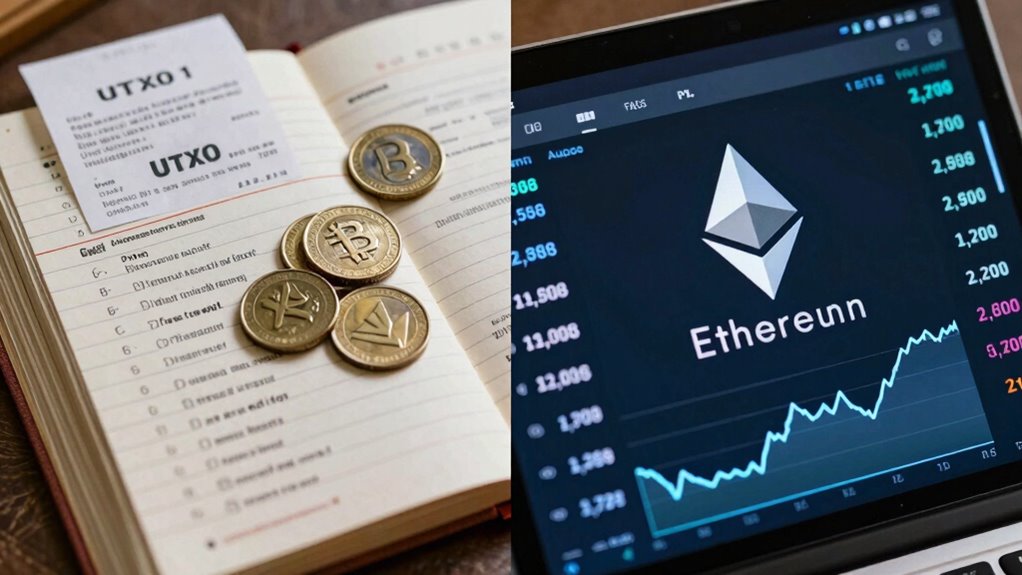
The underlying structure of UTXO and account models considerably influences how the crypto ecosystem functions and evolves. UTXO’s design promotes transparency and straightforward token standards, which simplifies tracking individual coins and enhances security. This model impacts governance mechanisms by enabling clear ownership and transaction history, fostering trust and accountability. Conversely, the account model streamlines interactions, making smart contract integration easier and supporting complex token standards like ERC-20. This flexibility shapes decentralized governance by allowing more dynamic updates and features within platforms like Ethereum. Overall, these models influence how users interact, how tokens are managed, and how governance processes are implemented, ultimately shaping the development, scalability, and user experience across the broader crypto ecosystem.
Frequently Asked Questions
How Do UTXO and Account Models Impact User Privacy?
You might find that UTXO models enhance privacy because each transaction creates new, unlinkable outputs, making it harder to trace your funds. Conversely, account models can reduce privacy since all transactions update a single account balance, increasing transaction traceability. Your privacy implications depend on the model used, with UTXO offering better pseudonymity and account models potentially exposing more transaction details.
Can UTXO or Account Models Influence Network Congestion Levels?
You might think transaction models don’t affect network congestion, but they do. UTXO models can improve transaction efficiency, reducing scalability challenges, because each unspent output is processed independently. This can lead to more parallel transactions and less clogging. In contrast, account models might face bottlenecks during high usage, impacting overall network performance. So, your choice of model influences how smoothly the network handles increasing transaction loads.
Are There Hybrid Models Combining UTXO and Account Features?
Yes, hybrid implementations combine UTXO and account features, offering the best of both worlds. These models enable you to benefit from UTXO’s transparency and security while enjoying the ease of account management. However, you should consider privacy implications, as hybrid systems can potentially expose transaction details more than pure models. Carefully evaluate how these implementations balance security, privacy, and usability before adopting them.
Which Model Better Supports Complex Defi Applications?
Honestly, the account model wins for complex DeFi applications. It offers superior smart contract flexibility, allowing developers to craft intricate, multi-layered protocols easily. Plus, it handles transaction complexity smoothly, making DeFi operations more efficient. If you want a platform that adapts to your wildest financial dreams without crashing, go with the account model—it’s like giving your DeFi universe a sturdy, expandable blueprint rather than a rigid box.
How Do Data Models Affect Long-Term Network Sustainability?
You should consider how data models influence long-term network sustainability, especially regarding scalability challenges and transaction complexity. The UTXO model tends to diminish transaction complexity, making it easier to scale over time, while the account model can face increased scalability issues as transaction volume grows. Choosing the right data structure helps prevent network congestion and ensures smooth performance, supporting sustainable growth for future decentralized applications.
Conclusion
Understanding the key differences between UTXO and account models helps you grasp how Bitcoin and Ethereum operate. Did you know that Bitcoin’s UTXO system processes roughly 4-7 transactions per second, while Ethereum’s account model supports more complex smart contracts? This distinction influences scalability and security. By knowing these differences, you can better evaluate each network’s strengths and limitations, shaping how you engage with the evolving world of cryptocurrency.